

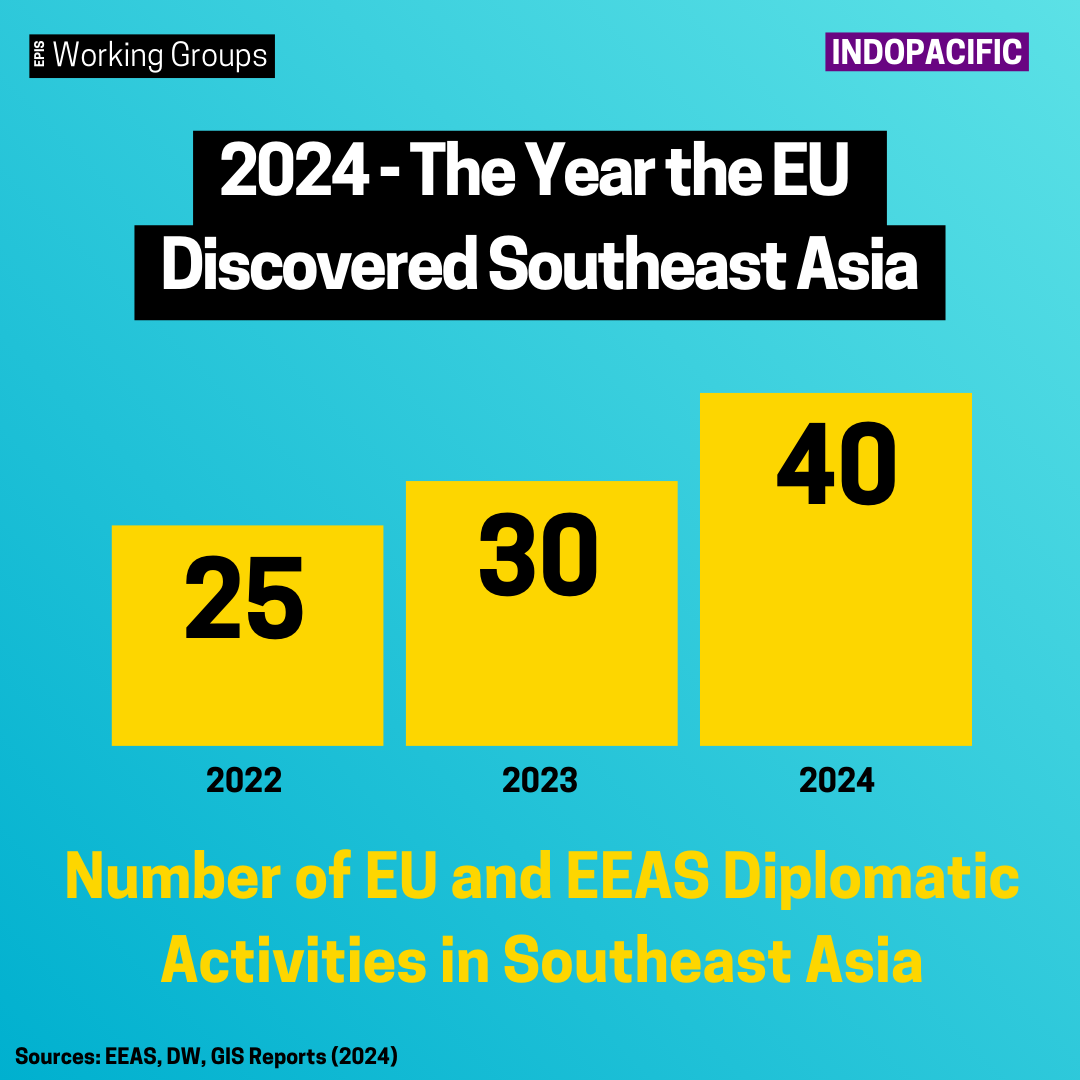
In 2024 the European Union, both its leadership and the media landscape has discovered a new interest for the region of Southeast Asia and for the future that this should have in the Global EU Strategy.
2024 – The Year the EU discovered Southeast Asia
In 2024 the European Union, both its leadership and the media landscape has discovered a new interest for the region of Southeast Asia and for the future that this should have in the Global EU Strategy.
In July the EU and ASEAN reached an agreement for education and research investment called Sustainable Connectivity Package (SCOPE). This programme will support research program in the ASEAN member states with a total value of €9.3 million until January 2028 and aims at strengthening student and academic mobility in ASEAN, fostering EU-ASEAN cross-regional university networks in research. In October Council President Charles Michel attended the yearly ASEAN Summit, this year occurring in Laos. In it maintained the desire of the EU of maintaining investment in the region. Meanwhile, EU’s embassy to the ASEAN in Jakarta is also increasing its activity with different policy actors and stakeholders in the region. The delegation has greatly increased its events and contacts with groups.
The area of Southeast Asia is considered by many as the future of the world’s attention. This is because the area is located in between the trade routes of the East and West and in an area in which China, India and the United States all wish to expand their own influence. The EU can used its position as a partially margial power to gain influence and presence without the fear of being dragged to their sphere of influence. Dr. Prashanth Parameswaran, Fellow at the Wilson Centre, determines that current trends indicate that in the near future, the EU will not only continue its partnership with Southeast Asian stakeholders but also there is the possibility of them asserting themselves as important actors in the development of crucial sectors in the region.
REFERENCES
Hutt, D. (2024, October 11). ASEAN summit: EU seeks to build bridges in Southeast Asia. dw.com. https://www.dw.com/en/asean-summit-eu-seeks-to-build-bridges-in-southeast-asia/a-70454646
EEAS. (2024, December). Strengthening statistical capacities in Southeast Asia. EEAS. ASEAN Delegation. https://www.eeas.europa.eu/delegations/association-southeast-asian-nations-asean/strengthening-statistical-capacities-southeast-asia_en
Parameswaran, P. (2024, April 17). Scenarios for European engagement in Southeast Asia. GIS Reports. https://www.gisreportsonline.com/r/eu-asean/#toc-pos-conclusion
EEAS. (2024a, July). EU, ASEAN team up to boost educational and research ties with EUR 9.3 million initiative. https://www.eeas.europa.eu/delegations/association-southeast-asian-nations-asean/eu-asean-team-boost-educational-and-research-ties-eur-93-million-initiative_en?s=47
Documents: 📄 Full Publication (PDF) 📂 Source Document