

It's crucial to approach discussions on the Israel-Palestine conflict with empathy and an open mind, recognizing the legitimate rights and grievances of both sides.
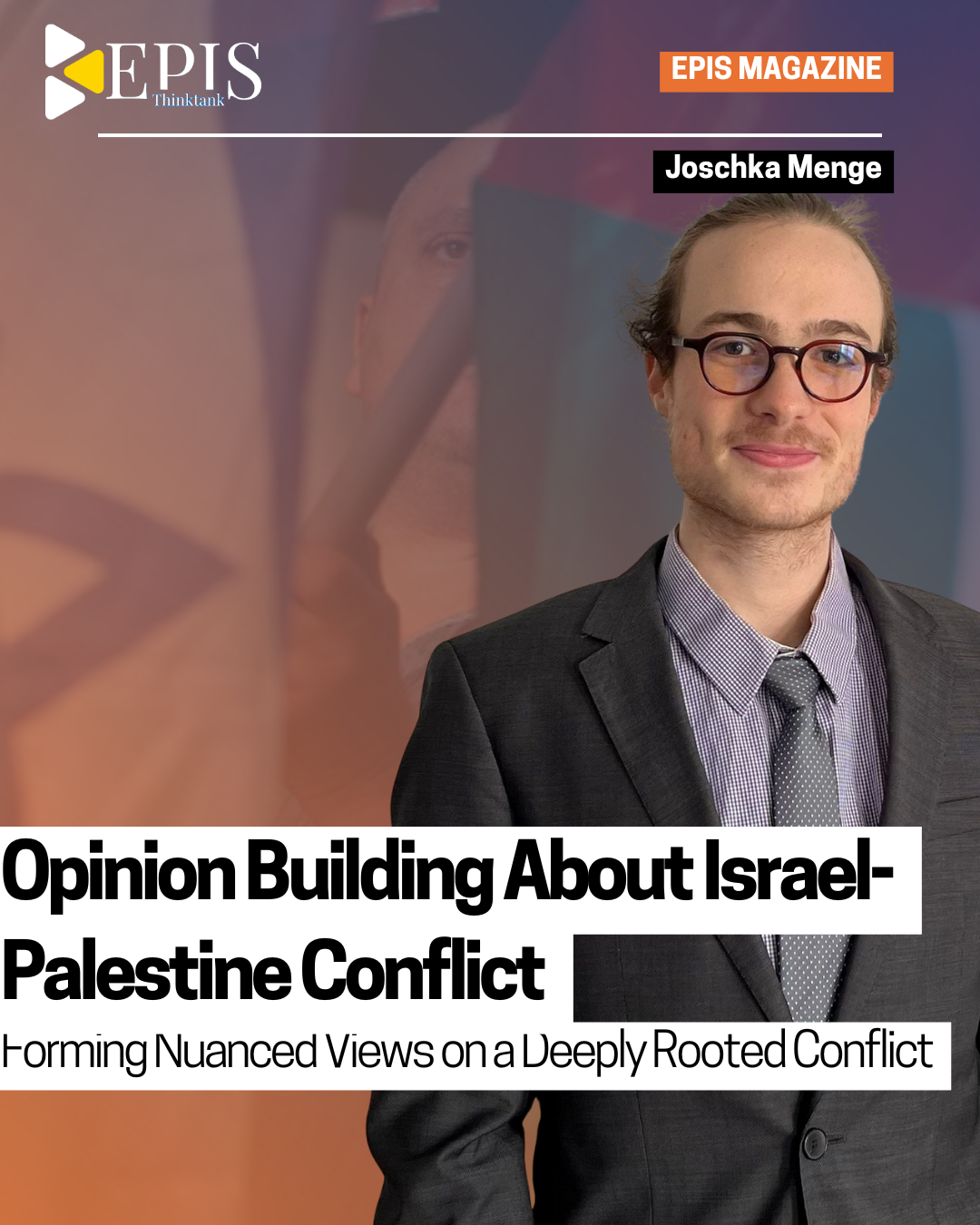
Opinion Building about Israel-Palestine Conflict
The Israel-Palestine conflict is one of the most enduring and complex geopolitical issues in modern history. The conflicts’ complexity makes it hard to easily form a clear opinion on that issue. It is rooted in deep historical, religious, and nationalistic disputes. At its core, it encompasses a struggle over land, peace, and sovereignty, with profound implications for the people living in the region and for international peace and security.
The origins of the conflict trace back to the late 19th and early 20th centuries, with the rise of Zionist and Palestinian nationalist movements. Both, the establishment of the State of Israel in 1948 and the subsequent wars and territorial disputes have led to prolonged suffering, displacement, and a cycle of violence affecting generations of Israelis and Palestinians.
Efforts to achieve a peaceful resolution have been numerous, involving bilateral talks, international mediation, and various proposals for a two-state solution, aiming to establish an independent Palestinian state alongside Israel. However, deep-seated mistrust, political divisions, and external influences have continually hampered these efforts.
It is undoubted that both sides need to be critiqued for some of their actions. On the one hand, the state of Israel’s needs to be critiqued in its policies and actions regarding Palestinians, particularly in terms of military occupation, settlement expansion, and the conditions in Gaza. Now, during the war, the state of Israel has hold off to supply the people of Gaza with food, water and medicine for a long time. Citing international human right organizations, like Human Rights Watch, almost 50% of all people in Gaza did not have access to clean water nor food at some point. On the other hand, the issues of anti-Semitism and the manipulation of the Palestinian cause by various global actors, like the Hamas, for their own political and religious ends is to be critiqued. Further, describing the bloody attack on Israeli civilians carried out by Hamas as a tragedy would be an understatement. Hamas’ technique to hide out in civilian targets like hospitals and schools is a disgusting way of waging a war and is nothing less but a tool to get Israel to take further casualties into account.
It’s crucial to approach discussions on the Israel-Palestine conflict with empathy and an open mind, recognizing the legitimate rights and grievances of both sides. Peace requires acknowledging the humanity of the other, understanding the complexities, and working tirelessly towards solutions that respect the dignity, security, and aspirations of all involved. The international community must support dialogue and practical steps that lead towards a just and lasting peace, ensuring that future generations of Palestinians and Israelis can live side by side, free from fear and conflict.
Personally, I find it very difficult to unconditionally support one or the other side of this conflict. Both sides, in their narrative, are on the right side of history. Though, I condemn any kind of violence as well as hate on either side. I believe it to be critical to examine one’s own biases and the ideological frameworks that shape our understanding of such conflicts, in order to fully understand our own position towards such conflicts.
As already mentioned above, both sides of the conflict are to be criticized. Further, it is urgent to have a nuanced understanding beyond conventional partisan perspectives. Furthermore, the role of global capitalism, ideological manipulation, and the impact of external political interests in perpetuating the conflict are not to be underestimated and need to be considered when forming a nuanced opinion on any conflict.
It’s crucial to approach discussions on the Israel-Palestine conflict with empathy and an open mind, recognizing the legitimate rights and grievances of both sides.
Documents: 📄 Full Publication (PDF) 📂 Source Document