
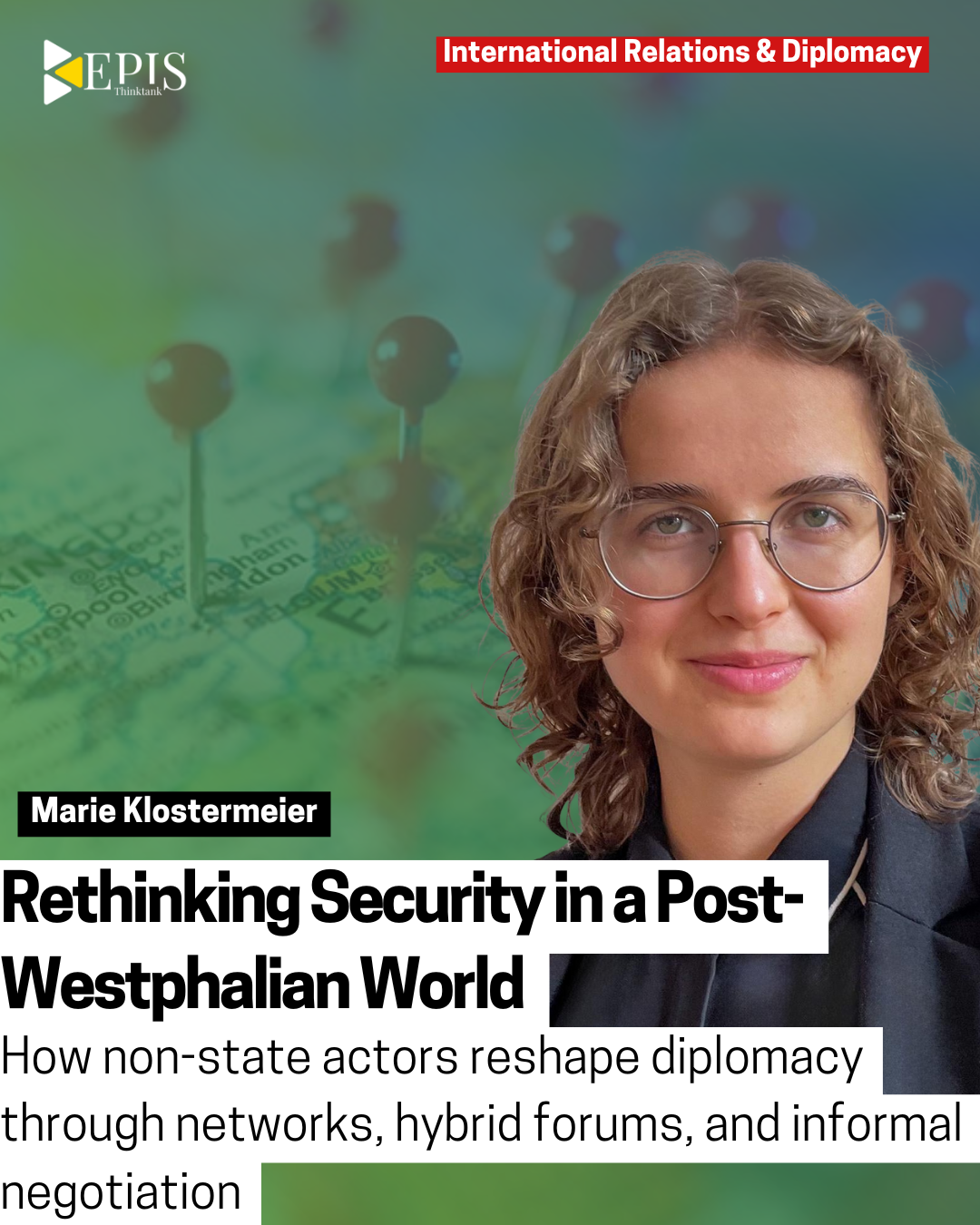

Non-state actors increasingly shape global security by using hybrid platforms and informal negotiations to influence outcomes once controlled exclusively by states.
EPIS Report Group International Relations & Diplomacy
Post-Westphalian Diplomacy: Rethinking global security beyond the state’s absolute power claim on the international stage
Author: Marie Klostermeier
The Westphalian system also made states the principal accepted actors on the international stage. This system itself is as old as the Peace of Westphalia of 1648. Yet over the past 377 years, global governance has changed profoundly. It is no longer only nation-states or their intergovernmental organizations that shape world politics. In today’s interconnected and complex global order, the classical notion of the Westphalian claim to absolute state control is increasingly under pressure. Non-state actors are playing an ever more significant role. This development now even affects security policy, the core domain of state sovereignty. Therefore, this article addresses the research question: How does the growing role of non-state actors transform the concept of global security beyond the state’s absolute power claim on the international stage?
The discussion sheds light on alternative forms of international cooperation and initiatives that operate beyond traditional state mechanisms. In this context, different tracks of diplomatic negotiations by hybrid forms of cooperation, think tanks, and network-based formats all play a role. The analysis explores how these non-state actors act as informal negotiators, how governance increasingly functions within networks rather than hierarchical structures, and how hybrid forms of diplomacy are employed. It becomes evident that the Westphalian system, with subordination of all other actors under states, is gradually softening and being replaced by a more decentralized, network-based system and flexible modes of collaboration between states and non-state actors.
However, this post-Westphalian understanding of security also raises important questions about democratic legitimacy, accountability, the fragmentation of the security architecture. The article thus aims to show that non-state security actors are establishing a complementary and adaptive form of diplomacy, one that highlights the shift in global security from exclusive state control toward dynamic, pluralistic networks. This development, however, must be critically assessed in order to determine whether it should indeed be regarded as a positive evolution.
In a state driven international order, Track One Diplomacy, referring to conflict resolution negotiations between official top leadership state actors, seems the most obvious platform for dialogue. But the landscape of conflict resolution is more differentiated. Track One negotiation can be complemented through various forms of non-state actor involvement (Federer, 2021). Even though classic diplomacy remains generally state-centric, especially in the 21st century we have seen a rise in non-state actors with global ambitions (Grincheva and Kelley, 2019).
This track division is part of a systematic view, dividing conflict parties into different tracks. Track One and a Half Diplomacy is closely related to Track One Diplomacy and includes unofficial dialogues among official actors. Track Two Diplomacy, referring to “informal, facilitated dialogues between influential representatives of conflicting parties to develop insights and ideas that can be transferred to formal negotiations and also communicated to the broader public.” (Jones et al., 2025, p. 169), enables Non-State Actors to act as informal negotiators. It refers to non-state actors with relatively high influence, like civil society elites. The least formal track, Track Three, includes community-based grassroot organizations (Jones et al. 2025).
Figure 1: Adaptation of the Lederach’s pyramid by Jones et al. (2025)
All these tracks can come into play at different stages of negotiation and in different grades of formalization. Especially Track Two and Track One and a Half can be found in various forms. It reaches from the beginning and the opening of dialogue, even before there is a formal process to broaden the scope of the negotiation by bringing in more actors. But it also includes various steps in between like keeping dialogue open, while official forms are stuck or frozen, or providing a space for detailed work that is not in the agenda of official actors (Jones et al. 2025).
Coming from this differentiation, in the following more specific cases will be assessed that exemplify what non-state actors can really do within this framework. By positioning the actors on this scale, it is not predetermined what activities they can offer. These reach from providing platforms or being an informal negotiator to outreach through hybrid hubs and governance networks.
2.1 (In)formal Platforms
The influence of non-state actors does not come by excluding or bypassing state actors, especially in Track One and a Half. But they have the power to influence international diplomacy by providing and shaping the way state actors come up with policy decisions and diplomatic solutions. One of the most common ways non-state actors can influence this arena where and how state-actors meet is by providing platforms with varying degrees of officiality. This relates to the role of keeping dialogue open by providing a steady format. These hybrid dialogue formats are mostly part of Track one and a Half by being led by non-state actors but supported by the attendance and given authority by state actors. This type of discursive space is especially valuable because it is under less tension than formal state meetings. It allows non-state actors to encourage more out-of-the-box solutions, besides providing a habit of dialogue (Longhini & Zimmerman 2021). This becomes clearer when looking at a very prominent example of this platform building through non-state actors: The Munich Security Conference (MSC).
The MSC is the oldest Track One and a Half security forum in Europe, founded in 1963 and is potentially still the most relevant one. It attracts the most influential leaders and allows the discussion of a range of security-relevant topics in different formats of discourse. It benefits from its layered architecture in a balancing act between public incineration and flexible informal gatherings. The conference offers more public aspects like panel discussions but also invitation-only, off-record sessions. A reason for productivity is that the MSC doesn’t force participants into false demonstrative unity, since the goal is not to produce a final communiqué or something similar. Participants are meant to become more approachable to enhance real dialogue. The MSC strengthens this goal, for example by alphabetical seating instead of hierarchical seating to maximize interactions (Longhini & Zimmerman, 2021). This enables numerous bilateral meetings and hundreds of confidential side events. These conversations, shaping the future of worldwide security policy, would most probably never happen in this amount and informality, if there were not important non-state actors like the Munich Security Conference, or the Asian Shangri-La Dialogue, that use their power in global governance in the era after the singular Westphalian-power-system.
2.2 Informal Negotiators
But non-state actors can also enforce their power without state actors in the first round, by including other non-state actors and societal elites, in the process. Through Track Two Diplomacy, private foundations, NGOs or universities get military advisors or civil experts in contact with foreign experiences, and alternative solutions to problems, so that these elites begin to think about security issues in a cooperative manner. This stage of socialization of a conflict focuses on making influential elites think differently about regional security, which afterwards affects state actors and Track One Diplomacy (Kaye, 2007). Notable actors in this area are historically The Stockholm International Peace Research Institute (SIPRI) or The Gulf Research Center (GRC). Oftentimes non-state actors organize Track Two workshops, even though many regional projects are also state funded. By including regional and social elites, track two dialogues can tailor concepts to better fit within the local security environment. These ideas can then be carried to a broader audience by including media or politics. The success of such initiatives depends on civil cooperation, which can be difficult to achieve in the conflicted societies in question. Nevertheless, Track Two initiatives can have real policy effects, especially over longer periods of time. However, this refers to a common dilemma in Track Two efforts, which means that the longer unofficial negotiations last, the more likely it is that participants lose influence and connection to the current government. An example of a successful Track Two Initiative would be the Stimson Center Dialogues, which enable confidence-building measures, which have resulted in implementation at official levels, for example in the ballistic missile flight test notification agreement (Kaye, 2007).
2.3 Governance Networks
The third portrayed way non-state-actors can become active in diplomacy is through governance networks. The Global Counterterrorism Forum (GCTF), founded in 2011, is an example of how an informal, apolitical and multilateral platform can offer a way for non-state actors to participate. The forum aims to coordinate international efforts in the fight against terrorism and support the implementation of UN commitments. Thereby the focus is not formal norm-setting, but recommendation and toolkits. The actors involved range from states and international organizations to security companies and scientific communities giving the forum a hybrid structure that shows how non-state actors are included in governance formats and increasingly co-produce global security outcomes. The GCTF also makes it clear that global governance is less an abstract organizing principle than an empirically established structure. By linking discourses, technical infrastructures, and organizational routines, new power configurations can be created for more efficient problem solving. Non-state actors influencing in such arenas show how flexible, informal cooperation of heterogeneous actors dynamically perpetuates the global order of security law (Rodilles and Sullivan, 2025).
Figure 2: Relationships among assessed actors
Post-Westphalian diplomacy enhances global security from an asymmetrical and hierarchical multilateral system (Gleckman, 2016) to decentralized networks of non-state actors, creating opportunities for flexible cooperation. The analysis demonstrates how non-state actors are assuming security policy functions that were traditionally reserved for states and illustrates how Track Two Diplomacy and certain non-state security actors are establishing a flexible form of diplomacy as a complement to state-centered foreign policy.
While the transformation from global security policy being an issue of government to being a governance issue can be seen as positive, some concerns remain. The fragmentation of the security architecture into several parallel-operating networks of state and private alliances makes it more difficult for coherent strategy development to emerge. But learning from the analysis of various cases of non-state actors as informal negotiators, especially in Track Two Diplomacy (Kaye, 2007), many initiatives may fail. This concerns the actors’ role as part of networks and as negotiators, as well as platform providers. Therefore, having several channels that involve non-state actors, or that are solely made up of non-state-actors trying to achieve progress in diplomatic negotiations is often the only chance of achieving at least one successful outcome.
Therefore, the shift towards post-Westphalian network structures is inevitable. Non-state actors not only enrich traditional forums in security policy, but sometimes they also fill gaps where governmental capacity is blocked or ineffective. This pluralization of actors also increases adaptability and opens channels for trust-building and technical cooperation that are very much needed in contemporary security policy.
References:
Documents: 📄 Full Publication (PDF) 📂 Source Document