
Thales serves as a system-critical "one-stop shop" for European defense, providing irreplaceable technologies across sea, land, air, space, and cyber domains to ensure strategic autonomy.
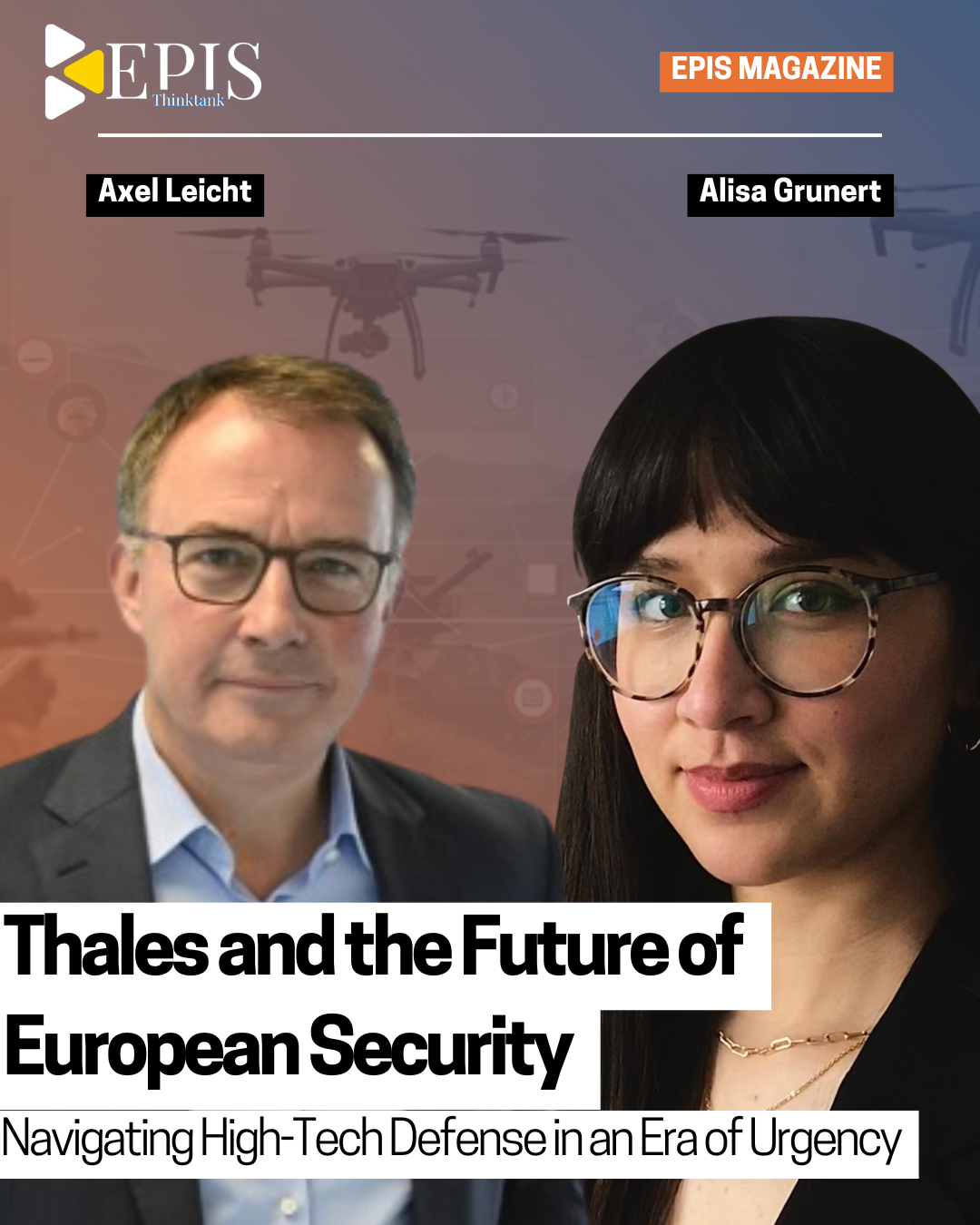
Thales and the Future of European Security: Navigating High-Tech Defense in an Era of Urgency
ALISA GRÜNERT: I’ll start with the first question. Please describe in a few sentences what brought you to Thales.
THALES: So the question is why I work at Thales.
ALISA GRÜNERT: Exactly, a little about your career path.
THALES: Yes, alright. So, I’m a former officer in the Navy. After twelve years of service, I wanted to stay in the defense industry or at least the defense-related industry. That’s why I joined Thales. I was mainly interested in the portfolio and the international nature of the company. I stayed there for three years, then took a ten-year break at what is today Airbus Defence & Space, before returning to Thales again, basically for the same reasons.
ALISA GRÜNERT: Before that, you had a military career and then moved into the company. What was the trigger for that?
THALES: The end of my military service, quite simply.
ALISA GRÜNERT: What role do you ,or rather Thales,play in the European security structure?
THALES: First of all, we are a system-critical company for German defense,for the Bundeswehr. I believe Thales holds an outstanding position among other defense companies as well. For example, in the area of radio equipment, where we supply radios to the Bundeswehr, the naval domain for naval systems like communications, or command and weapons systems on ships. We are also relevant in regards to simulation, where we build simulators for small arms and where soldiers train marksmanship as well as in crypto distribution and crypto management systems, we’re system-relevant for the Bundeswehr there as well.
ALISA GRÜNERT: So that’s at the forefront, essentially, those are the unique selling points compared to others?
THALES: I mean I’d say the defence sector is collaborative in spirit, but we are one of the manufacturers that supply the Bundeswehr, and because of that, we have a certain system criticality. If we were to disappear, there would be a gap,not one that no one could fill, but considering our product cycles, you can’t just switch suppliers for a weapons system or subsystems overnight. That simply doesn’t work. You need constancy within the defense-industry ecosystem. And Thales is one of the players providing things that can’t easily be replaced. For example, in the Navy, communication systems or command & weapons systems on ships. If Thales suddenly disappeared, you couldn’t replace that overnight; entire weapon systems wouldn’t function. That’s the kind of system relevance we’re talking about.We are also one of the few companies in Europe in the defense sector with a portfolio that truly offers a “one-stop shop.”
If you look at our defense, space, and cyber security portfolio, we cover everything, from the depths of the ocean,like sonar on submarines, over everything that swims, drives, and moves on land, all the way into space with satellites and satellite payloads. And everything is secured through our own cyber architecture. That makes us unique.
ALISA GRÜNERT: Thinking about strategic direction,has anything changed in recent years?
THALES: Yes, we’ve increasingly moved away from our civilian business. For many years, we had activities in the transport sector, ground transportation systems,railway systems, digital interlocking, and train control systems. We sold all of those activities across the group, including in Germany, to Hitachi, who took them over.
ALISA GRÜNERT: And since you already mentioned cyber,are there specific developments or technologies that are particularly relevant?
THALES: Yes, of course. We’ve been one of the pioneers from the beginning. As a group, we have invested almost 10 billion in recent years,organically and inorganically. Organically by building our own competencies, inorganically through mergers and acquisitions. So naturally, we’re at the forefront of technology,not only in cyber, but also in big data and artificial intelligence. We combine all that with an in-house Digital Factory, that’s our internal startup environment, where many young people and students help us drive new technologies forward. We also integrate external startups to secure talent pipelines and match the rapid innovation cycles in cyber, where the market increasingly demands solutions that don’t require ten years of development.
ALISA GRÜNERT: And when we talk about such short innovation cycles,how does cooperation with governments fit into that?
THALES: Well, that cooperation is always there,that’s our daily business. With “governments,” we mean procurement authorities. In Germany, that includes the Cyber and Information Domain Service (Kommando CIR), the Ministry of Defense, and so on.
ALISA GRÜNERT: Do you have examples from other countries?
THALES: Yes ,France, for example, has the DGA, the procurement authority, and specialized agencies. What also needs to be considered are the procurement processes in general. There are acceleration laws meant to ensure faster development and procurement. From an industry perspective, there is still room for improvement so that increased needs can be met quickly, and the end-user ultimately gets what they need in time.
ALISA GRÜNERT: What challenges arise from that? Even with those laws, how does it work in practice?
THALES: We do notice that procurement processes run faster than five or seven years ago,that’s clear. Partly due to new legislation. There are more direct procurements. Budget funds have been increased. Lower-level military units have been given their own budgets. So for small and very small procurements, the entire procurement chain doesn’t need to be activated. A brigade commander can purchase what their soldiers or their brigade needs—up to a certain spending limit.
ALISA GRÜNERT: In a global security-structure context,are these the same challenges that Thales faces?
THALES: Yes, certainly. It’s not a Thales-specific issue,it applies to the entire industry, to our customers in Germany, and in Europe as well. There’s pressure,especially in Europe,to become more autonomous in defense, to reduce reliance on the U.S. Not to abandon it, but to reduce it. And you can see that reflected in procurement processes as well.
ALISA GRÜNERT: If you had to describe the greatest challenge for the overall security architecture in just one word,what would it be?
THALES: Time. Time. Time.
ALISA GRÜNERT: We’re nearing the end. What expectations do you have of decision-makers from the perspective of Thales?
THALES: I think especially in these times, it’s important that the user, the procurer, and the industry move closer together. To reduce friction,there’s still a lot of that, driven by processes. We need to reduce it step by step. Ultimately for the benefit of the soldiers,those in the field, at sea, and in the air.
ALISA GRÜNERT: Since we are a student-run think tank,what expectations would Thales have of young people?
THALES: My appeal to you as young people: move through this new world with open eyes. Be open to new technologies, new topics, and new industries like ours. Compared to the traditional sectors that have been attractive for graduates,aviation, automotive, engineering, mechanical engineering,we also offer excellent jobs, great perspectives, and highly innovative technologies across the industry. And we urgently need young people. Young people are the future of this country,and we are not anymore. That’s just the reality.
Thales serves as a system-critical "one-stop shop" for European defense, providing irreplaceable technologies across sea, land, air, space, and cyber domains to ensure strategic autonomy.
Documents: 📄 Full Publication (PDF) 📂 Source Document