

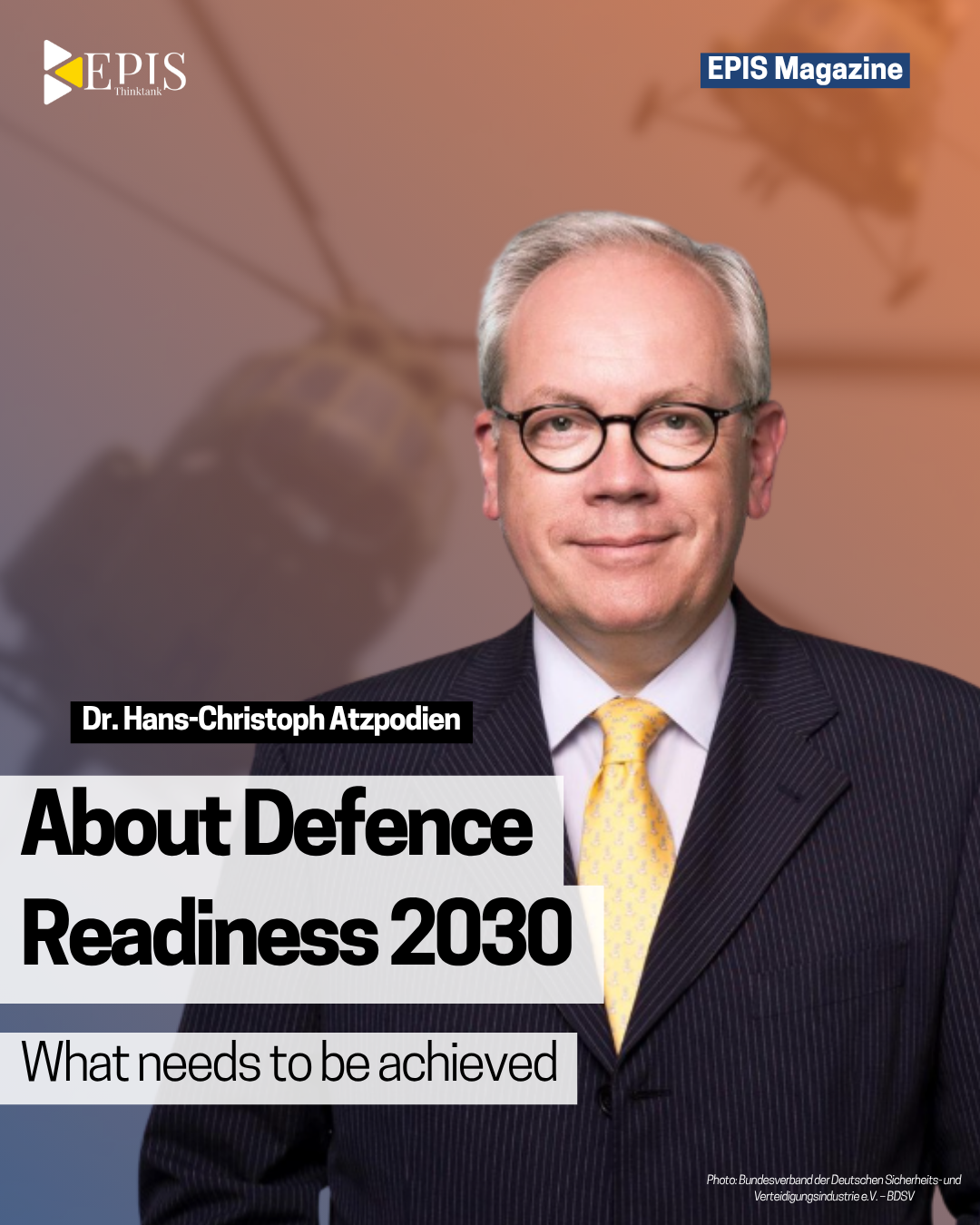
"I am confident that the European defence industry already provides most of the technologies needed to equip our armed forces."
Dr. Hans-Christoph Atzpodien, Managing Director of the Federation of German Security and Defence Industries (BDSV), Berlin
Contribution for the EPIS Magazine
About Defence Readiness 2030: What needs to be achieved!
The Joint White Paper published by EU’s High Representative Kaja Kallas and EU Defence Commissioner Andrius Kubilius in March 2025 was titled “on Defence Readiness 2030”. Yet, it addresses more than just urgent readiness. It also focuses on Europe’s ability to provide conventional armament for itself, as demanded by the Trump administration since February 2025, when the new US Defence Secretary Pete Hegseth visited his NATO colleagues for the first time in Brussels. Therefore, we are confronted with two different challenges: one being the short time available for defence readiness by 2030 (at the latest), and in the mid- to long-term, making sure that European NATO countries will be able to provide their own conventional military protection.
With this background, it is good to see that Europe has finally heeded the wake-up calls, not only from Russia’s ongoing war in Ukraine, but also from President Trump’s demand that 5 % of the GDP be spent by each of the European NATO countries for defence and defence-related infrastructure. While individual EU countries have to fulfil their commitments to NATO, the EU’s ReArm Europe programme is well suited to support such efforts, especially given the extremely short timelines. With the common goals addressed in the above mentioned Joint White Paper, and backed by the Defence Readiness Omnibus Plan, the EU appears to be on the right track to make Europe’s defence efforts more effective and collaborative.
Germany’s new coalition is drawing the right conclusions by massively increasing Germany’s defence budgets over the years to come. By 2029, Germany will spend 3.5 % of its GDP for defence and most likely the promised additional 1.5 % for defence-related infrastructure-measures. These are enormous sums, amounting to about 40 % of the projected federal budget for 2029. This reflects both the urgency of the situation, as well as the existing hybrid threats and attacks from which are already suffering. Some of these threats are neither widely known nor mentioned publicly, for example hostile drones monitoring our critical infrastructure. The reason for that is that we are still seeking appropriate protection measures. At least funding will from now on no longer serve as an excuse for failing to address these issues adequately.
Another field, which in the meantime has been identified and addressed, concerns burdensome regulatory hurdles. These must be removed both on the European as well as on the national level. To this end, the EU Commission initiated the “Defence Readiness Omnibus” package of measures, while the German federal government presented draft legislation to accelerate planning and procurement. This national draft contains several points long advocated by our federation under the label of creating an “economy of resilience”. We can say with some pride that our lobbying seems to have been quite successful so far.
However, exactly such success, will from now on translate into even higher demands for our industry’s ability to deliver. At present, we are confronted with aggregated orders by our own national customer as well as from other European clients, all of whom are on the course to buy, buy and buy. Industry therefore needs clarity on output volumes, in order to adjust capacities to the speed required. This may or may not involve new resources, which so far have not been used producing defence equipment. The good news is that our industry is receiving a range of such offers and inquiries. The problem could be that most of these resources still need to be adapted to defence-related purposes by earning additional certificates and qualifications.
The EU is launching further supportive initiatives under its programme ReArm Europe. One of ReArm Europe’s core elements is SAFE (“Security Action for Europe”). Germany will not directly benefit from the SAFE programme, as the €150 billion at stake will primarily attract countries that can take advantage of the preferential interest conditions offered by SAFE. Nevertheless, SAFE may encourage other EU Member States to cooperate with German partners, potentially also SMEs. All this, however, will only evolve in more cooperative products, if and to the extent that, the European governments and MoD’s will be prepared to procure such products. Political determination by EU Member States to foster armaments cooperation through their respective decisions will remain key to success.
Finally, during the US-EU talks about tariffs, it was confirmed that Europe continue to purchase military equipment from US-based suppliers. This stands in contrast to the EU White Paper, which clearly expressed the ambition to reduce procurement from outside the EU, particularly from the US, while at the same time setting the goal of increasing purchases from EU-based production. Both intentions, in my view, must be balanced. I am confident that the European defence industry already provides most of the technologies needed to equip our armed forces. Nevertheless, there are – and will continue to be – certain areas, in which cooperation with US manufacturers, and related procurement, makes a lot of sense for reasons of speed and technology.
Overall, the roughly 380 member companies of our association are currently facing the biggest challenge of the last decades: Fifteen years ago, the industry was largely neglected; only four years ago, under the European “Green Deal”, defence was branded as socially harmful. Now however, it must rapidly scale up production with the utmost diligence and speed to provide protection for our soldiers and deterrence for NATO. In the meantime, our society’s overall mind-set has shifted and the necessity of defence and armaments is again more widely accepted.. However, “pockets of resistance” remain, for example in universities, where so-called “civil clauses” are retained. Such clauses ban military- and defence-related topics from curricula and research agendas. Such attitudes do not reflect the contemporary threat environment. Public opinion needs to understand, that strength and our ability to deter aggression are the prerequisites for peace, security, freedom and consequently for sustainability. It’s the only way to preserve our way of life not only for ourselves, but also for future generations.
"I am confident that the European defence industry already provides most of the technologies needed to equip our armed forces."
Documents: 📄 Full Publication (PDF) 📂 Source Document