
LATEST NEWS
An Examination of Syria's Transitional Governance
...
...
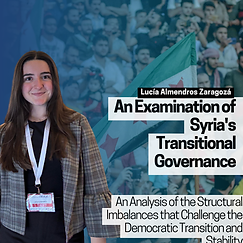
Since December 2024, Syria’s political regime has undergone significant changes. Although some democratic aspects may remain unmet, the actual regime strives to appear as a strong democratic regime. This article analyses the structural flaws and crises threatening the transition's democratic prospects. Through this brief, various points will be analyzed, such as the parliamentary elections, sectarian violence, political strategies, and news allies of the government.
MLA
I'm a paragraph. Click here to add your own text and edit me. It's easy.
CHIGACO
I'm a paragraph. Click here to add your own text and edit me. It's easy.
APA
I'm a paragraph. Click here to add your own text and edit me. It's easy.

3 Main Points
Since December 2024, Syria’s political regime has undergone significant changes. Although some democratic aspects may remain unmet, the actual regime strives to appear as a strong democratic regime. This article analyses the structural flaws and crises threatening the transition's democratic prospects. Through this brief, various points will be analyzed, such as the parliamentary elections, sectarian violence, political strategies, and news allies of the government.
About the Author
She's a Political Science student at the University of Salamanca, interested in International Relations and human rights. This year, she's participating in a student exchange program at Sciences Po Lille. In the future, she would like to work in think tanks. She's an Activist at Amnesty International, where she has developed communication skills by writing press articles. She participates in EU youth projects with EuropaDirect, which has expanded her knowledge of European politics.
An Examination of Syria's Transitional Governance
Subtitle: An analysis of the structural imbalances that challenge the democratic transition and stability.
Since December 2024, Syria’s political regime has undergone significant changes, facing new actors and popular acceptance. Although some democratic aspects remain unmet, the actual regime strives to appear as a strong democratic regime, seeking participation in debates and organizing its first parliamentary elections since Assad’s fall. This article analyses the structural flaws and crises threatening the transition's democratic prospects.
The illusion of a new dawn: staging democracy for the world
Indeed, on October 5th, Syria held its first elections after the fall of Saddam Hussein. During this poll, the interim Syrian president, Ahmed Al-Sharaa, aimed to convey an encouraging message to its population and the International Community, demonstrating that after decades of chaos, Syria could elude this authoritarian path. However, were these aspirations fulfilled? It is important to mention that one-third of the assembly was reserved for the interim leader's party. However, Al-Sharaa clarified that citizens would not be able to vote, as the country is still dismantling authoritarian structures and recovering from civil war, leaving many without ID cards. This stands in stark contrast to his public statements promoting participation: “Many pending laws (...) need to be voted (…) and all Syrians must contribute to it.” Furthermore, elections were postponed in regions opposed to the regime, such as the Druze-majority Sweida province, and areas controlled by the Kurdish-led Syrian Democratic Forces, due to tensions between local authorities and Damascus.
The Architecture of Control: Consolidating Power from Within
Several flaws are evident in this so-called ‘democratic procedure,’ which, in practice, ensures near-total control by the president’s party. One clear example is the strategy of reserving one-third of parliamentary seats for the president’s party. Democratic transparency and representation are essential to the foundations of a democratic state. Moreover, these elections have been created to name legislators who will be tasked with writing a new Constitution for the new regime, as it is currently still under a transitional period from 2025 to 2030. Yet, by reserving one-third of the seats, Al-Sharaa ensures a constitution aligned with his ideological vision. The exclusion of parties or groups opposed to his ideology further undermines democratic representation. For instance, HTS, the Islamist faction to which Al-Sharaa belongs, opposes the Druze community and especially the Alawites, the religious community of the previous president. Taken together, these factors indicate that the democratic intentions behind the constitution are limited, as the process prioritises consolidating the former president’s ideology over representing all citizens.
The Rebranded Warlord: from “Terrorist” to “Statesman” on the World Stage
This determination to implement his ideology and avoid sharing power with minorities like Druzes may have something to do with Al-Sharaa's past... Ahmed al-Sharaa was the leader of Syria’s Al-Nusra Front, which is why he was searched by the US for organizing “multiple terrorist attacks throughout Syria, often targeting civilians”. During his terrorist past, he waged an asymmetrical war against Assad’s regime, as his group confronted the national military forces. Today, he seeks to present himself as a statesman capable of ending sectarian violence, securing a role for Syria in regional relations, forging new alliances, and lifting international sanctions that strangle the Syrian economy, including the US Caesar Syria Civilian Protection Act of 2019. That is why he is the first Syrian leader to attend the UN General Assembly since 1967.
The Unhealed Wounds: Sectarian Violence and the Crisis of the Disappeared
Since Al-Sharaa’s rise to power last December, violence has not really decreased. Alawites have been associated with the Assad regime since 1970; they are part of the Shia branch of Islam, and are also a minority in a majority-Sunni state as Syria. HTS claims that Alawite members committed crimes against Sunnis during the Civil War, using this as justification for targeting them. After Assad’s fall, some civilians sought revenge, attacking Alawites in the absence of transitional justice. In March 2025, Alawite gunmen opened fire on regime security forces. Over that month, more than 1.400 Alawites were killed because of their faith, an incident now under consideration by the UN as a possible war crime.
Transitional Justice and National Reconciliation
This is not the only challenge the government faces. The new regime must implement transitional justice to collect evidence, hold accountability, and rebuild trust. Additionally, the government must account for approximately 160.000 people still missing since the Assad era, many of whom were imprisoned in facilities such as Saydnaya. Providing answers to their families is essential for national reconciliation and long-term stability.
The Patronage Network: Moscow’s enduring Shadow and the Quest for Allies
Given these internal challenges, but also the complex Middle East situation, Al-Sharaa pursues regional allies. Russia’s position and interests are relevant in this “flexible diplomacy” that Russia maintains towards Syria. Indeed, the Russian president had great relations with Assad, and still has military interests in Syria, as he possesses military footholds there: the Tartus one gives Russia access to a water port, and the Khmeimim one to Africa. Both States agreed that Russia could use its military footholds for military purposes, while Russia provides Syria with affordable resources, such as oil or grain. However, Russia isn’t the only ally Syria is seeking; Al-Sharaa is also meeting with Trump, European, or Gulf leaders. Moreover, the external ministries of India and Syria have signed policies to promote health and educational cooperation. India’s will is to avoid letting this Syrian space to other states, which they could exploit to develop their power, and to secure trade and energy routes that go through Syria, given their actual tensions with Iran.
An Unstable Foundation
It can be concluded that Al-Sharaa pursues a dual strategy: he is projecting a democratic, human-rights–oriented image, but at the same time maintaining control at home. His domestic policies continue to allow the exclusion of minorities. Although he presents himself as the architect of an alternative to Assad’s regime, in practice, he appears to be constructing a state with a constrained political, public, and democratic landscape.