
LATEST NEWS
The Arctic’s Economic Future
...
...
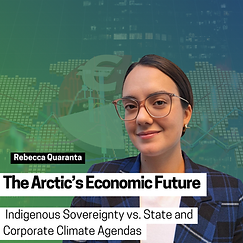
Can the Arctic become a new economic frontier without sacrificing Indigenous rights and ecosystems? While economic interest in a thawing Arctic grows, Indigenous sovereignty and environmental stability remain under threat. Sustainable development in the Arctic must center Indigenous voices and protect fragile ecosystems from extractive ambitions.
MLA
I'm a paragraph. Click here to add your own text and edit me. It's easy.
CHIGACO
I'm a paragraph. Click here to add your own text and edit me. It's easy.
APA
I'm a paragraph. Click here to add your own text and edit me. It's easy.


The Arctic’s Economic Future:
Indigenous Sovereignty vs. State and Corporate Climate Agendas
The Arctic is a territory laden with mystery and adventure, but could it be the arena for a new economic era; a “cold rush”?
At 66° 33' 45.9" north of the Equator the begins the Arctic , a land shrouded in mystery and uncertainty. This region has a surface area of about 14.5 million square kilometres, is surrounded by eight countries and home to about four million people of which roughly ten percent can be classified as Indigenous populations (Arctic Review, 2024). Under the current threat of climate change, the scenery is undergoing rapid changes that are creating a certain frenzy about the untapped (economic) potential of a warmer and more navigable Arctic.
Increased water temperatures and shorter winters could imply the permanent opening of the Bering Strait as a new and stable shipping route, significantly decreasing both time and costs for larger freighters transiting between Asia and North America, the potentially untapped oil and gas reserves promise huge monetary gains. But economic impacts represent only one side of climate change in the Arctic. We must consider that the natural systems, as well as the original inhabitants of the icy north, will be greatly affected. The aim of this essay is to present a clear, detailed and 360° view of all the aspects that should be considered when evaluating the Arctic’s economic viability.
Figure 1: Map of the Arctic region (Hermes)
2. The triple effects of Climate Change in the Arctic
The indigenous arctic populations have long been disproportionately affected by national and supranational trends and decisions. The initial exploratory frenzy, as well as sovereign state’s historically unchallenged claims to occupied lands has caused the indigenous peoples of the Arctic circle to be a marginalized and underrepresented group until the very recent past.
Pushed into a corner, torn from their ancestral lands and traditions, especially via residential schools, these peoples continue to bear the consequences of a suppressive past. Some scholars have put forth the term historical trauma to highlight the transgenerational effects early forced assimilation had on First Nation communities (Wilk, Maltby, & Cooke, 2017). Canadian Inuit People face major challenges in many key socio-economic indicators of well-being, such as, infant health, employment opportunities, housing shortages, access to education, food security, healthcare and personal safety (Inuit Tapirit Kanatami, 2014). Inuit communities also have a higher degree of mental health issues and suicides compared to Canadian national levels. These heightened levels have been directly linked, by some, to the long-run effects of colonialism (Prince George, 2012).
Climate change is no longer a fringe discussion; it is a well-established macro trend with well-established consequences. While measurement and data collection is arduous given the remoteness of the region, rising temperatures affect nine key areas specific to the Arctic (Walsh J. E., Overland, Groisman, & Rudolf, 2011). During the 47-year interval between 1971 to 2017, Box et al found the following:
While worrying, the physical impacts of climate change on the region are quite straightforward in consequences and interpretation, in terms of the socio-economic impacts and possibilities, the situation is rather nuanced. While the arctic circle is certainly not a desolate and uninhabited region, having an existing stable population and economy, its remoteness and the harshness of its conditions cannot be overlooked. Even the most proactive citizen and entrepreneur must consider the instability of the territory as well as the lack of heavy infrastructures before choosing to begin a venture there. A mixed economy is crucial to Indigenous well-being and life satisfaction, as climate change will inevitably impact the economic and social spheres local governments must start laying the foundations for optimal levels of employment without forgetting that a percentage of subsistence activities are directly tied to indigenous traditions and are charged with cultural importance (Poppel, Kruse, Duhaime, & Abryutina, 2007).
Thawing ice could lead to potential new shipping routes bolstering connections in the global North. Some sources claim an immediate 40% in cost reductions, but other scholars are much less optimistic with the maximum cost reduction achievable by 2050 being 37% (Quillérou, et al., 2020). The reason for such a high discrepancy in numbers could be attributed to the high level of risks (currently) associated with making heavy investments, necessary to support a new and sustained economic wave in such an environment. The most obvious industries that would be unlocked by a more permanent increase in temperatures and stabilizing of weather conditions would be: shipping, fishing and aquaculture, oil, gas and mineral extractions. Perhaps a little more surprising is the potential for the development of a strong tourism and service industry sector as well as a satellite manufacturing industry in support of the others (Stephan, 2018). Building on the issues discussed in the previous section, an evolving economic context will greatly impact local communities. Climate change coupled with the rise of commercial fishing and agricultural practices could lead to a decrease in native stocks with consequent changes to local diet and traditional food availability. Extractive industries have been linked to shrinking Caribou population, a fundamental source of traditional food and customs (hunting and tracking). Tourism is one of the fastest growing sectors of the region, due to improved infrastructure as well as awareness and the general public’s demand for last chance tourism. If allowed to evolve naturally, without any consideration or limitation, tourism will cause grave disruptions to cultural traditions and indigenous’ interactions with nature, the main attraction. Furthermore, disruption to individual and collective relationships with place and emotional and cultural attachment shifts are plausible effects of both increased industrial activity and increased tourism flows (Arruda & Krutkowski, 2016).
3. Indigenous Sovereignty
In terms of advocacy tools available to the Inuit, the two main institutions are the Inuit Circumpolar Council and the Arctic Council. While these institutions have been instrumental in providing an important platform for indigenous voices, they often have only been granted an observatory role in national or supranational proceedings.
The UNDRIP (United Nations Declaration on the Rights of Indigenous Peoples) affirmed the right to “self-determination” implying that First Nations have the right to self-organize, and to some extent set their own priorities in economic, social and cultural matters (United Nations General Assembly, 13 September 2007). Interestingly, Australia, Canada, the United States and New Zealand initially voted against this declaration.
When it comes to indigenous sovereignty it has often been framed as a subset of national law, which has granted First Nations the right to self-govern, but only until a certain extent. Christie calls for a radical mindset and linguistic shift in the way we imagine and talk about the Arctic. He claims that most Inuit in Canada welcome their title of Canadian citizen and actively and willingly collaborate with state governments, never questioning the States unchallenged claim to what was once undoubtedly and fully Inuit territory, as they can no longer imagine their ancestor’s relationship with their land (Christie, 2011). Jurisdiction, national sovereignty, territory as a bounded and limited expanse (often including permafrost and frozen bits of the Arctic Ocean), through these terms the original colonizers created a new web of meanings opposed to traditional Inuit ones which they then used to enhance their claims to the far north.
Figure 2 - Inuit traditions in a warming Arctic (Johnson, 2019)
State representatives are quick to acknowledge the continued historical presence of indigenous inhabitants when this can be leveraged as a basis for ownership (Gerhardt, Steinber, Tasch, Fabiano, & Shields, 2010) yet as of today, the Arctic Council does not have any legal binding authority towards its members. While some goodwill has been shown by local governments (especially Canada) to make reparations and further involve indigenous knowledge in local policy-making, de facto, they are not considered strong legal actors. “…international legal and co-operative frameworks that disproportionately concentrated power in state actors to the detriment of Indigenous sovereignty and the right to self-determination, both concepts understood here as conveying Indigenous ownership and authority over territory and resources, at multiple scales of governance. “ (Khan, 2019).
4. Conclusion
If we observe the territorial, geophysical and legal uncertainty of the region, it is perhaps too soon to entertain the idea of a mass economic and social shift (a “cold rush”) occurring within the next one to three years. Yet, undeniably there is noise, the Arctic is of great interest to top players, both commercial and political (Exxon, President Trump, etc.), considering the potential untapped economic gains it promises. It is steadily gaining a central place in the collective consciousness no longer as a barren wasteland but as a land of opportunity and unspoilt beauty. Given the blighted past of exploitation and marginalization that the territory and its peoples endured so that the pockets of a select oligarchy could inflate beyond imagination. In light of this track record, policy makers, advocates and statespersons must immediately lay the groundwork for a respectful and sustainable growth. One that takes into account the social as well as environmental impacts of increased industry and tourism in the far north. Indigenous and Inuit voices must be called upon, not solely as observers, expert voices or historical memories, but as active participants and decision-makers. Undoubtedly there is a wealth of resources currently sitting unused in the extreme north, resources which rising temperatures could render more readily available, but there is a long way to go before the Arctic can be considered safe enough and having sufficient infrastructure to become economically viable. Business players, local and international governments and activists alike should consider this shoulder time very carefully and immediately begin laying the foundations for the magnitude and direction of this seemingly inevitable economic development. Future regulations should be guided by principles of social justice and climate consciousness which will be necessary to safeguard indigenous people’s rights to self-determination and to their natural environment.
References
Arctic Review. (2024). People - Population. Retrieved from Arctic Review: https://arctic.review/people/population/
Arruda, G. M., & Krutkowski, S. (2016). Social impacts of climate change and resource development in the Arctic Implications for Arctic Governance. Climate Change.
Box, J. E., W. T., C., T. R., C., N. M., S., Lund, M., & Parmentier, F. J. (2019). Key indicators of Arctic climate change: 1971–2017. Environmental Research Letters, 14(4).
Christie, G. (2011). Indigeneity and Sovereignty in Canada's Far North: The Arctic and Inuit Sovereignty. The South Atlantic Quarterly.
Gerhardt, H., Steinber, P. E., Tasch, J., Fabiano, S. J., & Shields, R. (2010). Contested sovereignty in a changing Arctic. Annals of the Association of American Geographers, 992-1002.
Hermes, P. (n.d.). Furian/Shutterstock,. Retrieved from https://www.livescience.com/arctic-circle.html
Inuit Tapirit Kanatami. (2014). Social Determinants of Inuit Health in Canada. Inuit Tapirit Kanatami.
Johnson, A. (2019, September). National Geographic.
Khan, S. A. (2019). Rebalancing state and Indigenous sovereignties in international law: An Arctic lens on trajectories for global governance. Leiden Journal of International Law, 675–693.
Means, T. (2020, July 8). The Arctic Circle: Polar portal to the Arctic. Retrieved from Live Science: https://www.livescience.com/arctic-circle.html
Nicol, H. N. (2010). Reframing sovereignty: Indigenous peoples and Arctic states. Political Geography, 78-80.
Poppel, B., Kruse, J., Duhaime, G., & Abryutina, L. (2007). SLiCA Results. Anchorage: Institute of Social and Economic Research. Anchorage: University of Anchorage.
Potravnaya, E. V. (2021). Social Problems of Industrial Development of the Arctic Territories. Journal of Siberian Federal University. Humanities & Social Sciences, 1008–1017.
Prince George. (2012). The state of knowledge of Aboriginal health: a review of Aboriginal public health in Canada. BC: National Collaborating Centre for Aboriginal Health.
Quillérou, E., Jacquot, M., Cudennec, A., Bailly, D., Anne, C., & Zakrewski, L. (2020). The Arctic: Opportunities, Concerns and Challenges. Scientific Fact sheets of the Ocean & Climate Platform, 73-87.
Stephan, K. (2018). Societal Impacts of a Rapidly Changing Arctic. Current Climate Change Reports, 223-237.
United Nations General Assembly. (13 September 2007). United Nations Declaration on the Rights of Indigenous Peoples. UN Doc. A/RES/61/295.
Walsh, J. E., Overland, J. E., Goisman, P. Y., & Rudolf, B. (2011). Ongoing Climate Change in the Arctic. Ambio.
Walsh, J. E., Overland, J. E., Groisman, P. Y., & Rudolf, B. (2011). Ongoing climate change in the Arctic. Ambio, 40, 6-16.
Wilk, P., Maltby, A., & Cooke, M. (2017). Residential schools and the effects on Indigenous health and well-being in Canada - a scoping review. Public Health.