
LATEST NEWS
“They Call It Peace, But We Cannot Fish”
...
...
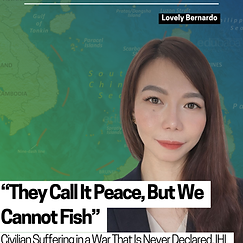
1.Does sustained, non-kinetic maritime coercion in the South China Sea generate legal obligations under international humanitarian and human rights law despite the absence of declared war?
2.China’s effective control over access to Scarborough Shoal reshapes Filipino fishermen’s livelihoods, triggering protective duties under IHL, human rights law, and UNCLOS.
3.Civilian harm exists below the threshold of armed conflict; peace without access, security, and dignity is not true peace.
MLA
I'm a paragraph. Click here to add your own text and edit me. It's easy.
CHIGACO
I'm a paragraph. Click here to add your own text and edit me. It's easy.
APA
I'm a paragraph. Click here to add your own text and edit me. It's easy.


“They Call It Peace, But We Cannot Fish”: Civilian Suffering in a War That Is Never Declared. International Humanitarian and Human Rights Law in the South China Sea
By Lovely Bernardo
2226 words
Author’s Note
This article is drawn from a larger LLM research project on maritime coercion in the South China Sea and its legal consequences. Much of the international discussion about these waters focuses on strategy, naval balance, deterrence and competing legal claims. Warships, diplomatic protests and arbitration awards dominate the narrative.
Beneath these high-level exchanges are quieter, deeply human stories. Before dawn, small wooden boats push off from Philippine shores. Families wait throughout the day, hoping the catch will be enough to cover rice, fuel and school expenses. Fishing grounds that once felt like inherited space now feel distant, uncertain, and sometimes out of reach.
This article turns toward those stories. It examines how sustained, non-kinetic maritime coercion by China, through coast guard patrols, maritime militia presence, access restrictions and constant surveillance, reshapes the everyday lives of Filipino fishing communities. It argues that even without open warfare, the exercise of power at sea can erode livelihoods, heighten fear and undermine human dignity in ways that international humanitarian and human rights law are designed to address.
The absence of declared war does not mean the absence of civilian harm; hence they are still ought to be protected.
For many coastal communities in the Philippines, the sea is not simply a resource. It is inheritance, memory and life. Knowledge of currents, reefs and seasonal fish patterns passes from parent to child as deeply as instinct itself. Places like Scarborough Shoal are not abstractions on a map. They are woven into daily life, stories and identity to Filipinos.
Over the past decade, however, reaching these traditional fishing grounds has increasingly meant encountering Chinese coast guard vessels and maritime militia ships. These state-backed forces are larger, steel hulled and use their physical presence to exercise a form of power that is sustained and unmistakably authoritative in practice (PCA, 2016).
Filipino fishermen describe being shadowed for hours, cut off from entry points, or warned away through loudspeakers. Some report being allowed to fish only under the close watch of Chinese vessels. Others turn back immediately, fearing confrontation or damage to their boats. The imbalance of power is visible from a distance. Small wooden bancas face ships designed for law enforcement and strategic presence (Bernardo, 2025).
Each decision to sail becomes a calculation of risk. Should they try to reach familiar waters and risk being blocked or chased? Or should they remain closer to shore, where fish stocks are thinner and competition is greater?
These are not strategic decisions. They are survival choices shaped by the growing control China exercises over access to key fishing areas.
Because the pressure exerted by China at Scarborough Shoal does not usually involve gunfire or explosions, it is often described in technical language as grey zone activity or non-kinetic coercion. These actions are designed to operate in the “ambiguous no-man’s-land between peace and war”, allowing a state to achieve strategic objectives without triggering a conventional military response (Mazarr, 2015) .
For fishing families, however, the experience feels neither abstract nor restrained.
A day without access to productive fishing grounds means less food and less income. Repeated days like this mean debt. Fuel must still be purchased. Nets must still be repaired. Children still need to be fed and sent to school. When boats return half-empty or empty, the loss ripples through entire households (ICESCR, 1966; FAO, 2015). The harm is cumulative. It settles slowly into daily life. Families reduce meals, borrow money at high interest, or postpone medical care. Some fishermen travel farther into deeper, rougher waters, risking storms and accidents. Others consider abandoning fishing altogether, even though it is the only livelihood they know (FAO, 2015).
Alongside economic strain is the quieter weight of fear. Encounters with Chinese vessels create psychological stress that lingers long after boats return to shore. Fishermen speak of anxiety before each trip, of scanning the horizon not for fish but for ships. The sea, once a place of familiarity and skill, becomes a space of uncertainty and vulnerability (Bernardo, 2025).
This is not the spectacle of war. It is the slow compression of civilian life under sustained external maritime pressure.
International humanitarian law is typically associated with declared wars, armed clashes and occupation of territory by ground forces. At first glance, tense standoffs between fishing boats and coast guard vessels may seem far removed from its traditional domain.
The foundational concern of IHL is the protection of civilians when they come under the authority or effective control of a foreign power. While traditionally applied to land, the law of occupation provides a lens to analyse this maritime control. Under Article 42 of the 1907 Hague Regulations, a territory is considered occupied when it is placed under the authority of a hostile army (Hague Convention IV, 1907). Importantly, the form that control takes can evolve over time. Today, authority may be projected not only through physical presence on the land, but also through persistent maritime enforcement that effectively determines who may access essential resources and restricts the activities of local populations.
While some legal scholars argue that occupation requires physical presence on land, others contend that effective control exercised through persistent enforcement (ICJ, 2004), like in the case of Scarborough Shoal, fulfills the functional criteria of occupation under Article 42 of the Hague Regulations (Hague Convention IV, 1907). This doctrinal divergence underscores the need to prioritise civilian protection over rigid formalism (Bernardo, 2025).
The law of occupation offers a useful analytical lens. It focuses on effective control (ICJ, 2024) rather than formal declarations. Its purpose is to ensure that when a population is subject to foreign authority, its basic welfare and rights are not disregarded (Geneva Convention IV, 1949). While Scarborough Shoal is not a populated town, it is a vital source of livelihood for coastal communities. Control over access to this space has direct consequences for civilian survival (FAO, 2015).
When Chinese vessels regulate entry, dictate conditions of fishing, and effectively limit the ability of Philippine authorities to exercise their own jurisdiction there, a form of functional control over access emerges. Whether this situation meets the strict legal definition of occupation remains debated in doctrine. Still, the humanitarian logic underlying occupation law remains relevant (Bernardo, 2025). Civilians should not lose protection simply because control is exercised through patrols at sea rather than boots on land (Geneva Convention IV, 1949).
International human rights law provides a complementary and often clearer framework. Human rights obligations do not stop at a state’s territorial borders when that state exercises power or effective control over individuals or over access to essential areas abroad. Where state agents shape the lives and options of people beyond national territory, legal responsibilities may follow (Al-Skeni v United Kingdom, 2011).
For Filipino fishermen at Scarborough Shoal, China’s maritime forces are not distant actors. They are, in practice, the determining authority over whether boats may reach certain fishing grounds, how long they may remain, and under what conditions they must leave. These decisions directly affect access to food and income. The right to an adequate standard of living, including food (ICESCR, 1966; CESCR, 1999), is central here. Fishing is not a discretionary activity for many coastal families. It is the foundation of household survival. When access to traditional fishing grounds becomes restricted or unpredictable due to sustained Chinese maritime presence, the impact on food security and livelihood is immediate and profound (FAO, 2015).
There are also implications for personal security and dignity. Being pursued, surrounded, or warned away at sea creates fear and humiliation that law cannot ignore (Human Rights Committee, 2018). Human rights protections extend beyond protection from physical violence. They address sustained patterns of control that erode the ability of individuals to live with security and self-respect.
The psychological burden of constant uncertainty, never knowing whether one will be able to work in familiar waters, is part of the human impact of maritime coercion.
The United Nations Convention on the Law of the Sea is often described as a technical framework governing maritime zones and navigation. Yet, its allocation of rights over marine resources has a deeply human purpose. By granting coastal states sovereign rights in their exclusive economic zones, UNCLOS supports food security, economic development and social stability for coastal populations (United Nations, 1982; FAO, 2015).
The 2016 South China Sea Arbitration award clarified that Scarborough Shoal lies within an area where the Philippines enjoys resource-related rights and that China’s expansive maritime claims lack legal foundation (PCA, 2016). This clarification reinforced a framework designed to ensure that marine resources sustain coastal communities rather than become instruments of geopolitical pressure. When Chinese vessels continue to interfere with Filipino fishing activities despite this ruling, the consequences extend beyond legal disagreement. The disruption of access to resources undermines the very human interests that UNCLOS seeks to protect.
Seen this way, the law of the sea forms part of a broader protective system. It helps define who has authority over resources and, by implication, who bears responsibility for ensuring those resources sustain human life rather than become tools of coercion (United Nations, 1982; PCA, 2016).
One reason the situation at Scarborough Shoal receives limited humanitarian attention is that its harm unfolds gradually. There are no sudden waves of displaced people and no single catastrophic event. Instead, vulnerability accumulates through smaller catches, empty plates and deepening insecurity.
This gradual erosion of resilience is harder to capture in headlines and policy briefings. Yet, from a protection perspective, it is no less serious. Communities exposed to sustained external maritime pressure face long-term decline that can be as devastating as more visible crises. Humanitarian and human rights systems are not always well adapted to respond to this kind of grey zone harm. Mandates often hinge on armed conflict or clear jurisdictional triggers (Mazarr, 2015). Maritime spaces that fall between war and peace can slip through institutional gaps, even as civilians continue to bear the burden.
Recognising these situations as protection concerns is a crucial first step. Monitoring incidents at sea, documenting impacts on livelihoods and integrating maritime coercion into human rights analysis can help ensure that affected communities are not left in legal and practical limbo.
Scarborough Shoal is often framed in the language of strategy, deterrence and maritime power. But beneath these abstractions are fathers returning home with empty nets, mothers stretching meals to last another day and children growing up in households shaped by uncertainty at sea.
China’s sustained, non-kinetic maritime coercion in these waters may fall below the legal threshold of armed conflict, but it does not fall below the threshold of human consequence. International humanitarian and human rights law exist to restrain how power is exercised over people, especially when they are vulnerable and far from decision-making centres.
The challenge is to recognise that suffering does not have to be explosive to be real. Slow, quiet control over access to essential resources can wound just as deeply. For the fishermen of the South China Sea, the issue is not whether their situation looks dramatic enough to qualify as a crisis. It is whether the law, and the international community, are willing to see that peace without security, access and dignity is not truly peace at all.
“True peace is not merely the absence of tension; it is the presence of justice.”—Martin Luther King, Stride Toward Freedom (1958)
Bernardo, L. (2025). Non-Kinetic Coercion and Unlawful Control in the South China Sea Signaling China’s De Facto Annexation of Scarborough Shoal [Unpublished master’s thesis, European University Viadrina, Germany].
Committee on Economic, Social and Cultural Rights. (1999). General comment No. 12: The right to adequate food (Art. 11) (UN Doc. E/C.12/1999/5).
European Court of Human Rights. (2011). Al-Skeini and others v. United Kingdom (Application No. 55721/07).
Food and Agriculture Organization of the United Nations. (2015). Voluntary guidelines for securing sustainable small-scale fisheries in the context of food security and poverty eradication.
Geneva Convention (IV) relative to the protection of civilian persons in time of war, August 12, 1949, 75 U.N.T.S. 287.
Hague Convention (IV) respecting the laws and customs of war on land and its annex: Regulations concerning the laws and customs of war on land, October 18, 1907.
International Court of Justice. (2004). Legal consequences of the construction of a wall in the occupied Palestinian territory (Advisory Opinion). ICJ Reports, 136.
International Covenant on Economic, Social and Cultural Rights, December 16, 1966, 993 U.N.T.S. 3.
Mazarr, M. J. (2015). Mastering the gray zone: Understanding a changing era of conflict. U.S. Army War College Press.
Permanent Court of Arbitration. (2016). The South China Sea arbitration (The Republic of the Philippines v. The People’s Republic of China), PCA Case No. 2013–19, Award on the Merits.
United Nations Convention on the Law of the Sea, December 12, 1982.
United Nations Human Rights Committee. (2018). General comment No. 36: Article 6—Right to life (UN Doc. CCPR/C/GC/36).