

The fact that we are in a war basically means that regular diplomacy failed.
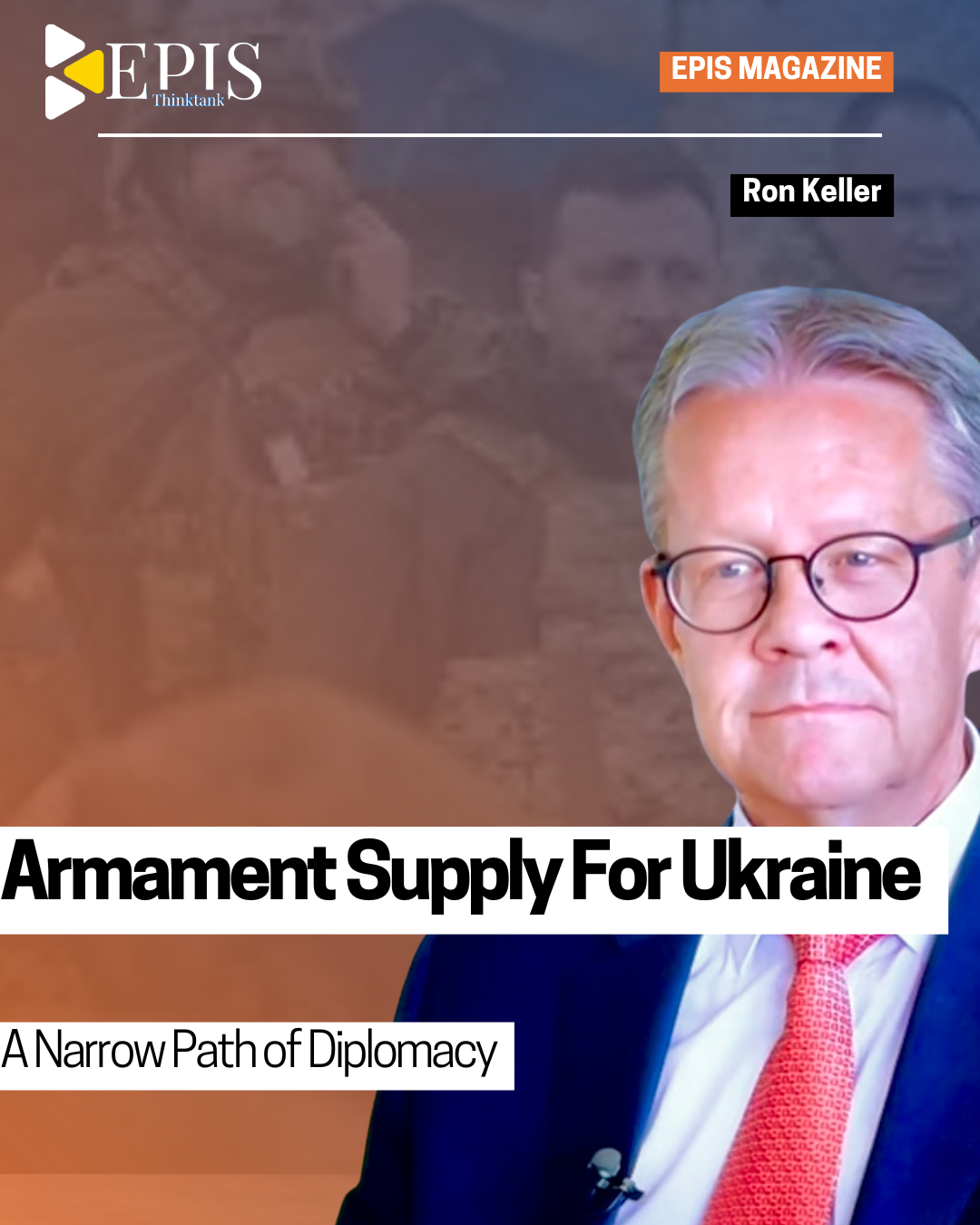
Armament Supply for Ukraine: A Narrow Path of Diplomacy
Himmel: As we are speaking about the Ukraine war, we are also speaking about military aid: should we provide military aid to Ukraine?
Keller: Military aid as in the current situation – yes. There’s no way back. We have to support Ukraine militarily, politically, financially, emotionally. This is not only a matter of European solidarity, but it’s also in our own interest.
Himmel: You mentioned four criteria. Starting off financially. As you have a background in finance, you are familiar with the fact that financial investments fail sometimes. So why don’t we resume after pumping 100 billion euros: We stop it, it’s not working out.
Keller: Because we’re not talking about a one-time investment. We’re talking basically about multi-year financing of the current expenditures of Ukraine. I mean the salaries of hospital workers, of teachers, of civil servants, therefore, not only the military. Expenditures that avoid Ukraine from completely collapsing. Since we cannot let this happen, we have to continue to provide Ukraine with financial support in the coming years.
Himmel: You also mentioned emotionally. Would you frame it like an ethical duty, moral obligation?
Keller: There are two sides of it. Number one, any country that is attacked by another country, neighbouring country, which didn’t provoke being attacked, should be supported by the world community. This principle should apply to any country in the world, and certainly to one, which is close to us. We are talking about European people losing their lives, their belongings and their relatives now. So, it’s a matter of solidarity. Number two, it’s also a matter of keeping the international standards of not going to war any more if you don’t like what your neighbouring country is doing. Instead, one talks and listens to each other from mutual respect. In this case, Russia shows no respect for Ukraine, and for agreed principles of international law and justice.
Himmel: You also spoke about military and political concerns. That brings me to other tools of diplomacy besides military aid. What would you, having been for many years an ambassador, say are some other tools of diplomacy?
Keller: The fact that we are in a war basically means that regular diplomacy failed. And I mean diplomacy in the widest sense of the word, because nowadays, traditional ambassadors are not the only ones responsible for political communication between countries. They are not the only “Botschafter”, the messenger, any more between countries. Nowadays, Prime Ministers and other officials at all levels call each other, and they meet each other regularly in international meetings. For instance, when I was working in the Dutch Finance Ministry on international affairs such as building the Euro currency system or preventing a collapse of highly indebted countries such as Brazil and Mexico, I basically also did diplomatic work.
Himmel: So, the cell phone made ambassadors dispensable. (laughter)
Keller: Yeah, (laughter) the cell phone makes sure to lower the threshold. But your question was, is there more than military and diplomacy? My answer is yes. Nowadays, in the world where people and countries are so closely connected, the wider relationship, including the history and the cultural developments, determines much more the interaction and communication between countries than what diplomats did in the past.
Himmel: Having set the status quo, what can we do now? How can those heated-up conflicts be dissolved? Conducting another conference, by allowing some successions?
Keller: Even in those deep conflicts, there’s always a tiny little window of talking. You see that Russia and the US are still talking, for instance, on avoiding nuclear threats. You see, for instance, the Defence Minister of Russia and Ukraine are talking about exchanging prisoners of war. This will not stop the conflict of fighting and open up a whole peace conference. But it may be the beginning of that. But talking about peace usually only occurs if either one of the two parties clearly wins, or both parties are exhausted. Russia is not going to win. If only because the West, the European and the United States, are not giving up supporting Ukraine. But Ukraine also will have a very difficult, if not impossible task to push the Russians out. Most likely, the scenario will be that two parties will end up in a stalemate. It could be triggered by the fact that Mr. Putin falls away or Mr. Zelenskyy is replaced. New leadership often brings in the opportunity of a new approach. Certainly, in countries being so vertically organized, that change at the top will make a difference. But also bear in mind that there is more continuity in these top-down organized countries than one thinks. If only because the new leader needs to explain to his own people that it is all of a sudden good to stop fighting. All the war rhetoric and all the propaganda from the past needs to be reversed.
Himmel: Could it also then be of help if the US and the Europeans are assisting Russia to create that image that an end of this war does not create an image of the “defeated one”.
Keller: Eventually, the Russian motive for this war is to regain respect. I talked a couple of dozen times to Putin, and he repeatedly said to me, Mr. Keller ´I do not understand why the West, with their expansion of NATO, further wants to humiliate me and the Russian people. We already lost the Cold War and the Soviet Union was dissolved. You want me to go further back into Siberia?´ We learned in 1918 after the First World War, to not humiliate the losers, and after the Second War to actually help the losing country to recover. Coming back to the shorter term of how will this conflict be resolved: for the time being, the only possibility is that both parties come to the conclusion of not being able to win this war. Most likely, this will happen only after both Zelenskyy and Putin have been replaced. There is perhaps an alternative option: a group of countries organizing a peace conference. Such an initiative could be taken by ‘neutral’ countries like China, India, Kazakhstan, or Saudi Arabia, accompanied by silent diplomacy, behind the scenes. But unfortunately, such a group does not exist yet.
Himmel: Would the relinquishment of Ukraine to pursue a NATO membership be a necessity for a peace deal obtained by such a conference?
Keller: Not necessarily. The whole conflict started with the 2008 NATO summit conclusion that Georgia and Ukraine would get the promise to become NATO members. When I met Putin a few months later, he said, ´if Mr. Yanukovych cannot bring Ukraine back to neutrality, then I will have to do the same with Ukraine, as what I did to Georgia.´ That is, to invade Georgia, which Russia did a few months after the NATO summit. When Yanukovych was ousted in 2013, Putin did what he already told me five years earlier: they started the frozen conflict in Ukraine, in Donetsk and Lugansk. And he illegally annexed Crimea. Now Russia went further because they feared that Ukraine would indeed become a NATO member, if only because now the Ukrainians will at all costs, want to have NATO membership. I do not see Ukraine and NATO giving up their desire to be together, even in possible peace negotiations with Russia in the future.
Himmel: As you are also a member of Euro Defence, what is the interest of Europe? We talked about respect for Russia. Is it not better for Europe or NATO to just leave Ukraine in the buffer zone rather than as a full member?
Keller: In 2008, we should have either left Ukraine neutral, which was for instance agreed with the Russians in the Budapest Treaty in 1996 and was in line with all the understandings and agreements made, or we should have made Ukraine instantly member of NATO. And giving it all the protection it already then needed against Russia. Unfortunately, we chose a compromise, which only postponed the military Russian reaction to Ukraine’s NATO ambitions. The problem is that in Europe, we do not have long-term strategic thinking about our geopolitical strategic interests. Bear in mind that the American geopolitical interests and the European ones coincided during the Cold War. But since the Cold War is over, Europe and the United States react differently to geopolitical challenges. One example: in December 1989, a few weeks after the fall of the Berlin Wall, the US voiced already concern about a united Europe.The Americans never trusted Russia, and certainly not that Russia could in a few years become a western oriented country. We in Europe chose the opposite: we opened the door for full cooperation and trust with Moscow. We saw a future of an integrated, peacefully working, cooperating Europe, including Russia. We now know that Europe was much too naïve. If the European Union would have had in 2008, a strong and united European foreign policy and a strong European defence corporation, Putin would not have dared to do with Ukraine what he did. And that’s why I’m an active supporter of the EuroDefence network, and I hope that this tragedy in Ukraine and in general in the world would make our politicians become much more visionary and more daring in the interest of future generations of Europeans.
Documents: 📄 Full Publication (PDF) 📂 Source Document