
LATEST NEWS
Berlin Security Conference 2025
...
...
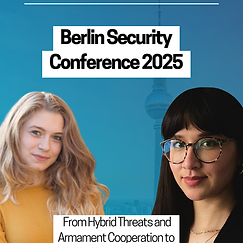
What did the Berlin Security Conference 2025 reveal about Europe’s evolving security challenges in an era of hybrid threats and geopolitical confrontation?
Discussions focused on strengthening European defence through NATO cooperation, increased defence spending, societal resilience, and technological innovation, while addressing urgent issues such as Arctic security, support for Ukraine, authoritarian coordination, and vulnerabilities across cyber, space, and critical infrastructure.
Europe’s security will depend on sustained political commitment, whole-of-society preparedness, and deeper cooperation with partners to deter and withstand future disruptions.
MLA
I'm a paragraph. Click here to add your own text and edit me. It's easy.
CHIGACO
I'm a paragraph. Click here to add your own text and edit me. It's easy.
APA
I'm a paragraph. Click here to add your own text and edit me. It's easy.


Berlin Security Conference 2025: From Hybrid Threats and Armament Cooperation to Russia and the Arctic
From November 18th to 19th 2025, EPIS attended the Berlin Security Conference with its biggest conference delegation to date. Ten students and young professionals had the opportunity to engage in high-level debates with military and political representatives as well as industrial stakeholders – from defence start-ups to cyber security companies. The 24th BSC once again reaffirmed its role as a central European platform for dialogue, strategic coordination, and policy innovation in security and defence. It brought together ministers of defence, military leaders, EU and NATO officials, industry representatives, and experts from across the Euro-Atlantic and Indo-Pacific regions.
Towards a strengthened Europe
This year’s partner nation was Sweden, marking its first BSC participation as a NATO member, symbolically and substantively reinforcing the alliance’s expanded northern dimension. A major milestone of the conference was the signing of a Memorandum of Understanding between German Defence Minister Boris Pistorius and his Swedish counterpart Pål Jonson. The agreement creates a framework for joint training, cooperative procurement of modern technologies, and improved interoperability between both countries’ armed forces. Pistorius described the MoU as a commitment to the soldiers of both nations, stating that Germany and Sweden can rely on one another “in peace and in crisis,” and emphasized that both countries share responsibility for the security of the Baltic region, of Europe as a whole, and for strengthening NATO in the face of renewed geopolitical threats.
Emerging vulnerabilities in the Arctic
Across multiple panels, NATO’s renewed emphasis on territorial defence and credible deterrence was a dominant topic. Speakers assessed progress on the alliance’s updated regional defence plans and underscored the urgent need for integrated, multi-domain capabilities spanning air, land, maritime, cyber, and space. The conference made clear that northern and Arctic security has moved more to European strategic thinking. Concerns over undersea infrastructure, Arctic routes, and hybrid vulnerabilities further underlined that the Baltic-Arctic theatre has become critical to Europe’s defence posture.
Financial spending necessities
The ongoing war in Ukraine remained a focal point. Ukraine’s Deputy Defence Minister highlighted that the battlefield has become a rapid-testing environment for new technologies and explained that the Ukrainian armed forces require additional financial support and long-term guarantees. He stressed that Ukraine’s security depends on Europe’s willingness to stand firm and that Europe’s own security depends on Ukraine’s resilience. European leaders, including the Swedish Prime Minister, echoed this sense of urgency, arguing that rhetorical solidarity is insufficient and that concrete action is required, particularly in the face of the coming winter. Airbus Chairman René Obermann pointed to Europe’s fragmented industrial landscape, arguing that approximately €50 billion would be enough to scale Europe’s promising defence startups into globally competitive companies, a figure he described as negligible in comparison to the annual internal expenditures of some major German corporations.
As partner nation, Sweden presented its strategic vision for defence in an era of heightened insecurity. The Swedish Prime Minister emphasized that “Defence Tech is Peace Tech,” highlighting that Sweden hosts an innovative and sophisticated defence industrial base that it intends to expand further through investments in fighter jets, submarines, and cyber infrastructure. Sweden remains committed to meeting the NATO benchmark of 5% defence spending by 2030 and stresses that national defence requires societal backing: security must be desired and supported by all parts of society, not only by political or military institutions. He warned against complacency, asking, “How long can you feel a sense of urgency without doing something?”
Anticipating disruption
The concept of ’’total defence’’ and societal resilience ran through the conference as a recurring theme. Speakers stressed that Europe is transitioning from crisis management to a posture of permanent preparedness, requiring governments, industries, and societies to operate seamlessly even under extreme stress. Civil defence now encompasses not only shelters and evacuation plans but also energy continuity, data security, psychological preparedness, and the capacity to maintain societal functions during prolonged disruption. Cybersecurity experts noted that recent distributed denial-of-service attacks and drone incursions should be understood as preliminary “test runs” designed to identify vulnerabilities. The warning was clear: Europe must prepare for adversaries who may already be inside critical systems.
Taiwan at the frontier of authoritarianism
A notable Indo-Pacific perspective was provided by Taiwan’s Deputy Minister of Foreign Affairs, Chihchung (Francois) Wu, who warned that China, Russia, Iran, and North Korea are intensifying their cooperation to form a cross-regional axis of authoritarianism. This bloc, he argued, poses a direct challenge to democratic states and global stability. Wu announced that Taiwan plans to increase its defence budget to USD 30 billion next year, aiming for 5% of GDP by 2030, in line with NATO standards. He drew parallels between Europe’s concept of “total defence” and Taiwan’s “whole-of-society defence,” stressing the importance of close ties between Europe and Taiwan to enhance joint resilience, supply-chain security, cyber preparedness, and the ability to withstand hybrid threats.
Novel technologies for old and new domains
Spanning a broad private-sector landscape and featuring many well-known names, one of the most vibrant aspects of the conference was the strong presence of Europe’s rapidly growing defence technology startup scene. The exhibition highlighted innovations across land systems, maritime and underwater robotics, cyber defence, and aerial technologies. Demonstrations included drones equipped with panoramic camera systems, graphene-based stealth enhancements, advanced AI applications, autonomous ground combat robots, and even automated kitchen robots already being deployed by the U.S. Army to support logistical operations. The energy and ambition of these startups illustrated how quickly Europe’s innovation landscape is evolving. Industry leaders reiterated that Europe’s defence industry is ready to scale, but long-term political commitment, streamlined acquisition procedures, and coordinated strategies across the EU, especially in domains such as space, are essential. Calls for a cohesive European space strategy were particularly strong, given that only three European space systems were launched last year, underscoring the need for sovereign capabilities in intelligence, communications, and orbital awareness.
What’s next?
During these two days in Berlin, EPIS was able to interview representatives from defence and politics – including ret. Brigade General Chris Badia and the Taiwanese Deputy Minister of Foreign Affairs Chihchung Wu (stay tuned!). In an era of hybrid warfare, deterrence must change its shape. The discussed whole-of-society approach only gives a hint of what is heading towards us. Overall, the Berlin Security Conference was a success for EPIS’ work and its connectivity within the security and defence landscape – emphasized in a future partnership with the BSC for next year.
By Bianca Kobald & Alisa Grunert.
Suggested Citation: Kobald, B. & Grunert, A. (2026). "Berlin Security Conference 2025". EPIS Blog.