
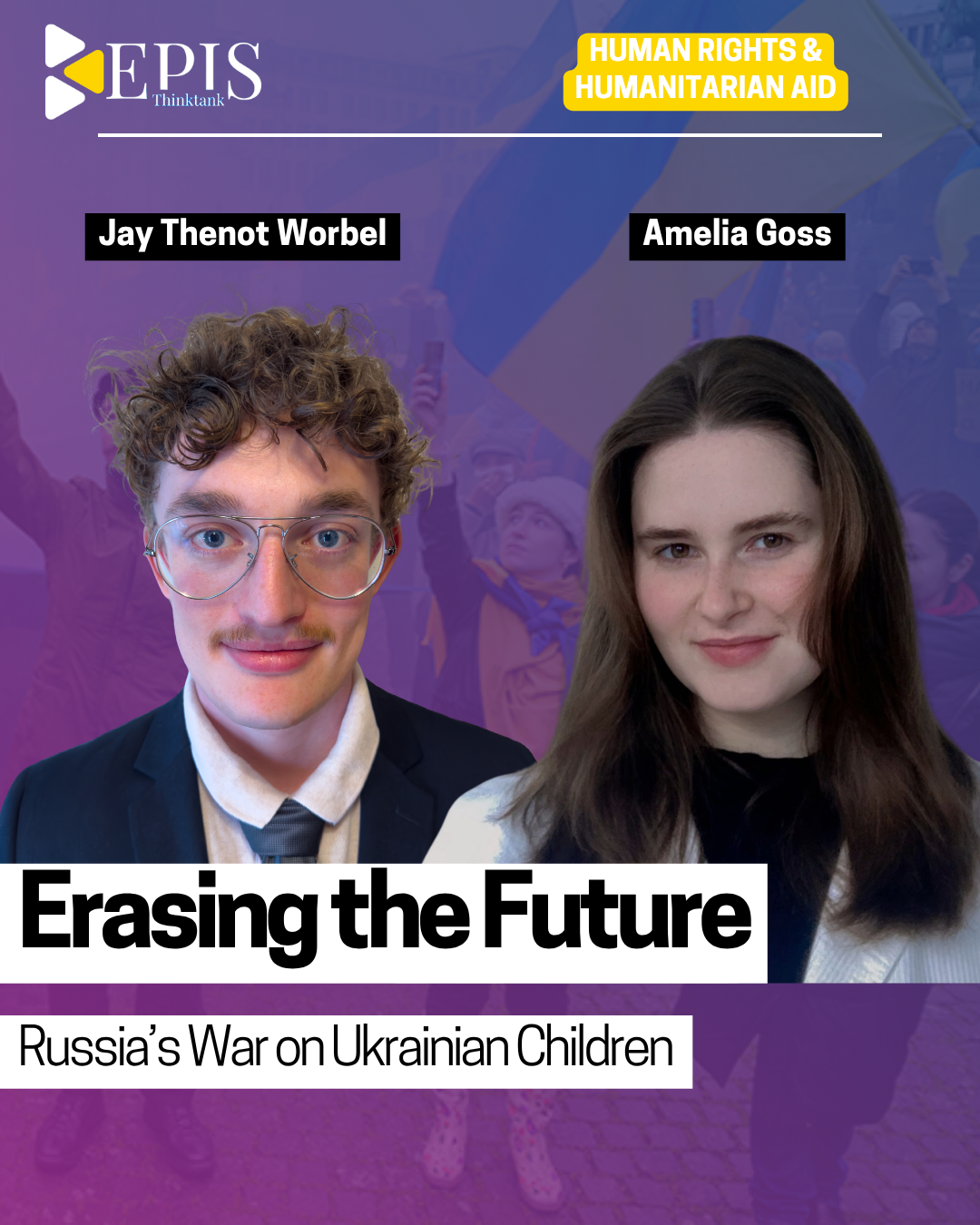
As of March 2026, 80% of children verified as deported by the UN remain unreturned, highlighting a calculated policy of permanent separation from Ukrainian identity.
Introduction
More than four years after the full-scale invasion of Ukraine, the war initiated by Vladimir Putin has been defined not only by imperial ambition but also by widespread human rights violations. Among the most alarming aspects of the conflict is the systematic targeting of Ukrainian children. Since 2022, thousands have been removed from occupied territories and transferred to Russia, where many are placed in state-run “re-education” programmes, subjected to ideological indoctrination, and in some cases adopted by Russian families. These practices sever children from their communities and erode their national and cultural identity. Notably, these operations are not concealed. Russian authorities have compiled databases cataloguing transferred children, many of whom are subsequently integrated into Russian society through language learning, patriotic education, and reassigned legal guardianship. The scale and organisation of these processes indicate a level of coordination far beyond the disorder typically associated with wartime displacement.
The international community has increasingly recognised the gravity of these actions. In March 2023, the International Criminal Court issued arrest warrants for Vladimir Putin and Maria Lvova-Belova for their alleged role in the unlawful deportation and transfer of Ukrainian children (International Criminal Court, 2023). These actions constitute serious violations of international humanitarian law and children’s rights. This report argues that such targeting is not an unintended consequence of war but a deliberate political strategy as the weaponisation of the next generation to serve Russia’s imperial ambitions. By removing children from Ukrainian territory and assimilating them into Russian society, this policy undermines Ukraine’s demographic future while advancing the ideological objectives of the Russian state, thereby amounting to a form of ethnic cleansing. To examine this argument, the report proceeds in three stages: first, it outlines the scale and nature of the violations; second, it analyses the mechanisms that demonstrate strategic intent; and third, it evaluates potential pathways for accountability and repatriation.
I. The Systematic Targeting of Ukrainian Children
According to the International Criminal Court, there are “reasonable grounds to believe” that Russian authorities have committed the war crimes of unlawful deportation and transfer of Ukrainian children into Russia (ICC, 2023). These children include orphans, children separated from their families during hostilities, and minors taken directly from schools, hospitals, and occupied communities. Any children that the Russian military have had access to easily have suffered forced removal from Ukrainian territory and have subsequently been placed into a highly organised policy of relocation and assimilation. Russian authorities have framed these actions as “evacuations,” citing alleged security risks posed by the Ukrainian government (Marusyak, 2023). However, evidence indicates that these transfers follow a coordinated process: children are initially moved to transit centres in occupied territories or within Russia itself, before being dispersed across at least 21 regions of the Russian Federation. There, they are placed either in state institutions or with Russian families, severing their legal and social ties to Ukraine.
Central to this process is what can be described as “re-education”, which can be defined as a systematic programme of ideological conditioning designed to reshape children’s cultural and national identities. In these settings, children are taught in Russian, exposed to state-sanctioned narratives that delegitimise Ukrainian nationhood, and encouraged to adopt a Russian identity. This includes learning a revised version of history, participating in patriotic activities, and being prohibited from speaking Ukrainian. Such practices extend beyond cultural influence into the deliberate erasure of national identity, aligning with recognised characteristics of ethnic cleansing, particularly the forcible transfer of children from one group to another. Estimates suggest that between February 2022 and March 2026, approximately 20,000 Ukrainian children have been deported or transferred into Russia (Bring Kids Back UA, 2026). Despite ongoing efforts by Ukrainian authorities, only 2,058 children have been successfully returned, highlighting both the scale of the crisis and the difficulty of tracing those whose identities have been altered through adoption or administrative reassignment. Notably, these practices are not concealed: Russian officials, including Maria Lvova-Belova, have publicly discussed the relocation and adoption of Ukrainian children, with Lvova-Belova herself reportedly adopting a child from Ukraine and praising her success in making the child love Russia. The visibility of these actions further underscores their institutional nature and reinforces the argument that the targeting of children is not incidental but embedded within broader state policy.
Furthermore, the human consequences of these policies are profound. Testimonies collected by humanitarian organisations and media investigations illustrate the psychological trauma inflicted on children subjected to these processes. Mykola Kuleba, a Ukrainian child rights advocate, recounts the case of a five-year-old boy who witnessed Russian soldiers beating and abducting his father — an experience that left the child with severe and lasting psychological distress. Such experiences are not isolated but indicative of a broader pattern in which children are exposed to violence, separation, and coercion before being transferred into unfamiliar and often hostile environments. Accounts gathered by the Ukrainian initiative Bring Kids Back UA further detail the conditions within so-called “re-education” camps. Artem, a 16-year-old student, was taken from his school and placed in a camp administered by Russian forces, where he and other children were subjected to strict discipline, limited food supplies, and compulsory ideological schooling. They were taught exclusively in Russian, reprimanded for speaking Ukrainian, and required to participate in acts of symbolic loyalty, including singing the Russian national anthem. Some children were explicitly threatened with adoption into Russian families if they did not comply, reinforcing the coercive nature of the environment.
Artem’s eventual return to Ukraine was largely due to the early stage of the invasion, when tracing mechanisms were still somewhat easier. However, his experience illustrates a broader pipeline: children are first detained or relocated within occupied territories, then transferred to camps where re-education takes place, and finally dispersed into Russia, where many undergo legal and identity transformations that make reunification with their families increasingly difficult. For thousands of others, this process results in what may be permanent separation. The cumulative effect is not only immediate harm but the long-term dismantling of personal, cultural, and national identity. By targeting children, these practices directly undermine the continuity of Ukrainian society. In doing so, they lend substantial weight to the report’s central argument that the targeting of children is not a byproduct of war but a deliberate strategy aimed at reshaping the future of a nation through the manipulation and assimilation of its next generation.
II. The Architecture of Eradication: Why This is a Deliberate Strategy
The evidence indicates that the deportation of Ukrainian children is a centralised, state-led policy rather than a series of uncoordinated military actions. This deliberate strategy is anchored in Russian legislative shifts, specifically Presidential Decree No. 330, which simplified the process for granting Russian citizenship to Ukrainian orphans and children without parental care (OSCE, 2023). This legal manoeuvre facilitates the “Russification” of children by stripping them of their original nationality and making their eventual repatriation nearly impossible under Russian law (Amnesty International, 2022). By unilaterally altering the legal status of these children, the Kremlin creates a veneer of domestic legality for acts that are classified as war crimes under the Rome Statute (International Criminal Court, 2023).
Furthermore, research by the Yale Humanitarian Research Lab (2023) has identified a vast network of at least 43 facilities across Russia and occupied Crimea dedicated to the “integration” of Ukrainian youth. These facilities are not merely temporary shelters; they are sites of political re-education where children are subjected to curricula that vilify Ukraine and glorify Russian imperial history (Yale Humanitarian Research Lab, 2023). The systematic nature of this process – beginning with “filtration” camps and ending in forced adoption – demonstrates a clear intent to destroy the cultural and national bonds of the Ukrainian group. This fits the criteria for ethnic cleansing and potentially genocide, specifically the “forcible transferring of children of the group to another group” (United Nations, 1948; Human Rights Watch, 2022). The goal is to solve Russia’s demographic crisis while simultaneously dismantling the future human capital of the Ukrainian state.
III. Breaking the Cycle: How the Crisis Can Be Addressed
Addressing this crisis requires the international community to move beyond the current state of symbolic condemnation and into a phase of active, multi-lateral enforcement. To date, the most significant international action – the 2023 International Criminal Court arrest warrants – has failed to halt the deportation pipeline because of a lack of enforcement mechanisms on the ground (OSCE, 2023). To break this cycle, a more aggressive policy framework is required, prioritising the following three pillars:
First, a UN-mandated child-tracking registry must be established to centralise data from intelligence agencies, NGOs, and the Ukrainian government. Current efforts are fragmented, making it difficult to verify the locations of children once they are moved into the Russian interior (Human Rights Watch, 2022). A centralised registry would create a permanent, internationally recognised record of every missing child, serving as a basis for future repatriation and criminal prosecutions.
Second, the international community must leverage third-party mediators – such as Qatar or the Vatican – to negotiate “blue-zone” humanitarian corridors specifically for children (Amnesty International, 2022). These corridors must be monitored by neutral international observers to ensure that evacuations lead back to Ukrainian-controlled territory rather than deeper into the Russian Federation.
Finally, the international community must address the “status quo” of limited engagement. Economic and diplomatic pressure must be linked directly to the return of children. Sanctions should be expanded to include all administrators of the re-education camps identified by NGOs (Yale Humanitarian Research Lab, 2023). Without a cohesive strategy that treats child abduction as an existential threat to the rules-based order, the “lost generation” of Ukraine will become a permanent reality, rewarding the aggressor’s policy of identity eradication (United Nations, 2024).
Conclusion: A Moral and Legal Mandate
The survival of the Ukrainian state is intrinsically tied to the return and protection of its children. As this Brief has demonstrated, the Russian strategy of deportation and re-education is not a chaotic byproduct of war but a documented, state-led effort to achieve ethnic cleansing through “genocide by education” (Yale Humanitarian Research Lab, 2023; Konrad-Adenauer-Stiftung, 2025). By March 2026, the UN Independent International Commission of Inquiry had formally concluded that these systematic transfers and the subsequent “enforced disappearances” of youth amount to crimes against humanity (OHCHR, 2026). The international community can no longer afford to be a passive observer of this generational theft; to do so is to accept the permanent erasure of a sovereign nation’s demographic core.
The legal landscape has shifted from mere condemnation to a mandate for active intervention. The December 2025 UN General Assembly resolution, supported by a two-thirds majority of 91 nations, established for the first time a clear international demand for the “immediate, safe, and unconditional” return of all children (UNGA, 2025). Furthermore, the 2026 findings of the UN Commission highlight the “unjustifiable delay” in repatriation as a distinct war crime, particularly as Russian authorities continue to obstruct the location of children by granting them fast-tracked citizenship and placing them in adoption databases in at least 21 different regions (OHCHR, 2026; OSCE, 2023).
To mitigate the long-term damage, the global community must move beyond ad-hoc returns. While third-party mediation by states such as Qatar, South Africa, and the Vatican has successfully returned nearly 2,000 children by early 2026, tens of thousands remain unaccounted for (Bring Kids Back UA, 2026; Global Affairs Canada, 2026)
Only by upholding the sanctity of international law and implementing these tracking and repatriation mechanisms can the global community ensure that children are never again used as “pawns of war.” The preservation of the Ukrainian identity is not just a regional concern; it is the ultimate test of the international legal order’s ability to prevent the state-sponsored eradication of a people.
References
Bring Kids Back UA. (2026). Children of War: National database statistics.
https://childrenofwar.gov.ua/en/
https://www.bringkidsback.org.ua/en/children
https://www.bringkidsback.org.ua/en/children/artem-returned-from-deportation-2022
International Criminal Court. (2023, March 17). Situation in Ukraine: ICC judges issue arrest warrants against Vladimir Vladimirovich Putin and Maria Alekseyevna Lvova-Belova. https://www.icc-cpi.int/news/situation-ukraine-icc-judges-issue-arrest-warrants-against-vladimir-vladimirovich-putin-and
Office of the United Nations High Commissioner for Human Rights. (2026). Report of the Independent International Commission of Inquiry on Ukraine (A/HRC/61/CRP.8). https://www.ohchr.org/sites/default/files/documents/hrbodies/hrcouncil/sessions-regular/session61/a-hrc-61-crp-8.pdf
OHCHR. (2026). UN Commission concludes that deportation and forcible transfer of Ukrainian children by Russian authorities amount to crimes against humanity.
Promote Ukraine. (2023, April 6). Dozens of countries condemn speech at UN by Russian official accused of organising deportation of Ukrainian children. https://www.promoteukraine.org/dozens-of-countries-condemn-speech-at-un-by-russian-official-accused-of-organising-deportation-of-ukrainian-children
Regional Center for Human Rights (RCHR). (2026). Weaponization of Children: Re-Education Camps.
https://rchr.org.ua/en/analytics/dity-yak-zbroya-t-abory-perevyhovannya/
Yale Humanitarian Research Lab. (2023). Russia’s Systematic Program for the Re-education and Adoption of Ukraine’s Children.