
South Korea maintains a high level of responsibility in the Indo-Pacific region, serving as the backbone of regional security, a reliable economic partner, and an anchor against authoritarianism.
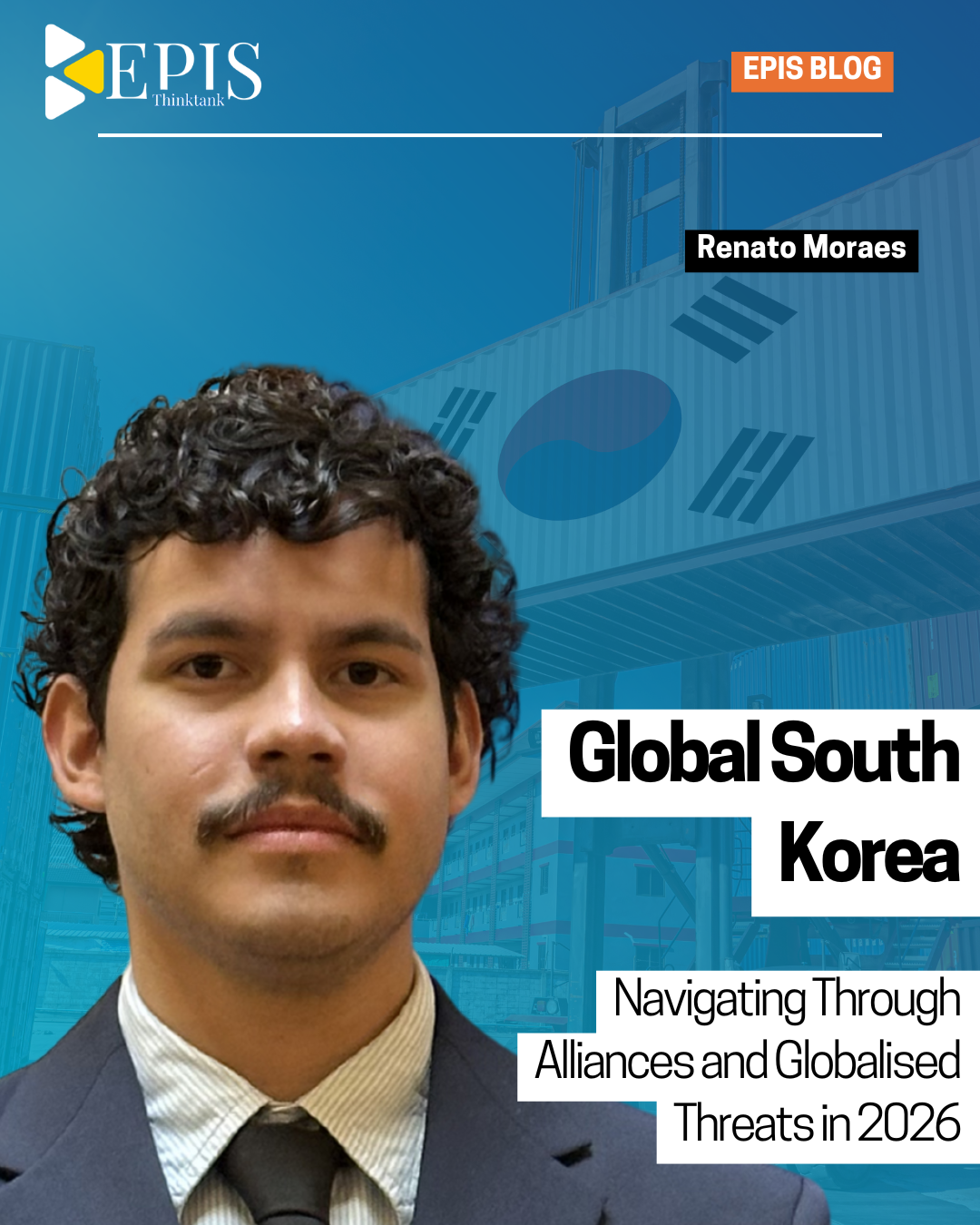
Global South Korea: Navigating Through Alliances and External Threats in 2026
The Republic of Korea (ROK) is facing multiple challenges and concerns in 2026. The Indo-Pacific region has become a central stage for global security issues and alliance frameworks. Major developments such as Russia’s full-scale invasion of Ukraine, China’s aggressive “wolf warrior diplomacy” and North Korea’s nuclear assertiveness have made South Korea prioritise not only domestic issues, focusing on its national security priorities, but also its deepened relations with Western countries and regional environment. Despite historical and complex ties, its relations with China are resurfacing; simultaneously, North Korea’s deterrence and readiness on the Korean Peninsula pose a challenging concern for the ROK.
South Korea – U.S. relations: an era of uncertainty
However, following the Trump administration’s “America First” foreign policy and the 2026 U.S. National Defence Strategy, the U.S. expects its allies to have greater autonomy and alliance burden-sharing when it comes to security affairs. This underscores the absolute need for South Korea to do more than rely on Washington in order to defend itself against external threats. Additionally, affected by Trump’s assertive tariff policies, the ROK been the target of several tariffs imposed on most South Korean exports to the U.S.
Nevertheless, Industry Minister Kim Jung-kwan recently declared that the Korea-U.S. tariff agreement will remain intact, solidifying South Korea’s commitment to its partnership with Washington and, by extension, the Western countries – a stance that can be seen as pragmatic yet questionable. Ultimately, Seoul will have to enhance its own security capabilities and economic strength while minimising possible ideological conflicts with Washington.
South Korea – China relations: recalibrating Sino-Korean ties
The relations between the People’s Republic of China (PRC) and the ROK in 2026 can only be described as a mutual wish of “full-scale restoration”. South Korea’s President Lee Jae-myung visited Beijing on January 5th 2026, only seven months after taking office. This could explain why this visit is being portrayed as a major political attempt at reconciliation, reflecting Seoul’s efforts to advance cooperation with Beijing in areas such as the digital economy, supply chains, advanced technology, and artificial intelligence. This delicate act represents Lee’s strategy to secure his country’s economic security and strategic autonomy amid global and regional uncertainties.
Nonetheless, China’s motives for this willingness to reconcile must be seen within a broader geopolitical context. Beijing appears to be using Lee’s 2026 state visit as an opportunity to reset Sino-Korean relations and counterbalance Seoul’s strategic drift toward Western security frameworks, such as its close relationships with NATO, the U.S., and the EU. Despite this, statements made by President Lee before the visit stressed avoiding confrontation with China, respecting the One China Policy, and maintaining a commitment to cooperation and development. Overall, Lee is playing a dangerous game by balancing ties with Washington while simultaneously trying to revive historical and diplomatic channels with Beijing.
Russia – North Korea relations: a direct security challenge for South Korea
During Kim Jong Un’s New Year’s speech on December 31st 2025, there is no mention of South Korea or the U.S., and few details about North Korea’s true intentions for 2026. At the same time, Pyongyang–Moscow relations are strengthening. There are around 8,000 North Korean troops deployed around Kursk Oblast, Russia, performing fire support functions under Russian command, according to Ukrainian military intelligence. This is highly dangerous for Seoul, as North Korea keeps building valuable military experience by developing new strategies and technologies that could be used against South Korea in the near future, such as artillery shells and ballistic missiles.
Additionally, Russia keeps opposing South Korean efforts to build nuclear submarines. As reported, Russian Ambassador to South Korea Georgy Zinoviev has said that South Korea’s efforts to acquire materials to build its first nuclear-powered submarine could violate the Treaty on the Non-Proliferation of Nuclear Weapons (NPT). This comes at a time when President Trump agreed to support South Korea’s development of nuclear submarines, which can only indicate the true meaning of Russia’s attempt to freeze these developments: the never-ending rivalry between Russia and the U.S., in which South Korea stands in an uncomfortable position.
Furthermore, in a very hypocritical manner, Russian Foreign Affairs Minister Sergei Lavrov has made it clear that Russia will veto any new sanctions on North Korea in the United Nations (UN) Security Council and continues to oppose discussions of North Korean denuclearisation. This facilitates the country’s rapid nuclear growth, leaving Seoul in a threatening position, where it can’t seem to find a way to develop its own deterrence, while Pyongyang does. These developments deepen already strained relations on the Korean Peninsula.
The limits of strategic balancing
In 2026, South Korea stands at a crossroads of intensifying geopolitical rivalries, shifting alliances, and global uncertainty. Its deepening engagement with the U.S. reflects a commitment to national and global security, as well as an alliance modernisation. Its renewed yet unpredictable reconciliation with China appears both necessary and risky. Finally, its deteriorating relationship with North Korea and Pyongyang’s proximity to Moscow only heighten tensions on the Korean Peninsula. Ultimately, South Korea’s challenge, not only this year but going forward, will be how to balance these power dynamics within a severely fractured international order, with the aim of guaranteeing its own security and development.