
LATEST NEWS
Implications of China–Russia Security Talks
...
...
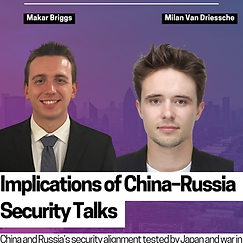
- How durable is China–Russia security cooperation, and how do Japan and Ukraine test its limits?
- The partnership is not an alliance but a flexible, institutionalised coordination that allows alignment while managing risk, asymmetry, and disagreement
- China–Russia security ties will persist but remain cautious and conditional, shaped by strategic signalling in Asia and constraints exposed by the war in Ukraine
MLA
I'm a paragraph. Click here to add your own text and edit me. It's easy.
CHIGACO
I'm a paragraph. Click here to add your own text and edit me. It's easy.
APA
I'm a paragraph. Click here to add your own text and edit me. It's easy.


Implications of China–Russia Security Talks
Introduction
In recent years, the strategic relationship between China and Russia has garnered attention as both states have increasingly coordinated their positions on international security and global governance. While often portrayed as an iron-clad partnership designed to challenge the Western-led international order, this partnership is more constructed out of convenience and strategy. Sino-Russian cooperation is characterised by flexible, forum-based coordination embedded in institutional frameworks that enable alignment while preserving strategic autonomy.
This brief analyzes the China-Russia strategic security partnership through three dimensions. First, it traces the historical institutionalisation of the relationship, focusing on the development of confidence-building mechanisms and the Shanghai Cooperation Organisation (SCO). It then examines Japan and Ukraine as two distinct contemporary cases that the Sino-Russian relationship is increasingly required to navigate, each placing different demands on strategic coordination. Japan is considered a regional case that highlights how alignment is expressed through diplomatic and military signalling in East Asia. At the same time, Russia’s war in Ukraine serves as a critical stress test of the partnership, revealing its limits and internal constraints.
Institutionalisation of the China-Russia strategic security partnership
In the twenty-first century, international security negotiations are increasingly mediated through institutionalised forums, which provide regularised spaces for consultation and signalling. Contemporary security cooperation is therefore best understood not as the product of isolated agreements, but as an ongoing process embedded within durable institutional frameworks. In the immediate post-Soviet environment, both states faced strategic uncertainty and shared concerns about regional instability, particularly in Central Asia. Russia was navigating post-imperial retrenchment while seeking to preserve influence in its near abroad, and China prioritised border stability and internal security to sustain economic reform. Both governments also shared an interest in preventing external powers, especially the United States and NATO, from expanding their security presence in Eurasia. These overlapping priorities created incentives for cooperation, but neither side sought a formal alliance. Instead, they pursued institutionalised confidence-building mechanisms that would stabilise relations while preserving strategic autonomy.
The earliest phase of Russo-Sino institutionalisation emerged through a series of bilateral and multilateral agreements in the 1990s, focusing on border security and military cooperation. These efforts culminated in the creation of the “Shanghai Five” in 1996, which brought together China, Russia, Kazakhstan, Kyrgyzstan, and Tajikistan to negotiate troop reductions, border demarcation, and peace-building measures along previously militarised and contested borders. This process was formalised in 2001 with two critical developments. First, Russia and China signed the Treaty of Good-Neighbourliness and Friendly Cooperation, which codified principles of sovereignty, non-interference, and long-term strategic consultation while deliberately stopping short of a mutual defence obligation. Second, the SCO was formally established with the inclusion of Uzbekistan, transforming the ad hoc Shanghai Five group into a permanent international organisation. The near conclusion of the sole bilateral relations, with the creation of the SCO, reflected a deliberate strategy to institutionalise Russo-Sino cooperation in both bilateral and multilateral forums simultaneously, as both China and Russia view states on the periphery as part of their sovereign oversight.
By the 2010s, the SCO had developed a dense institutional structure that formalised Russo-Sino interaction across multiple levels of government. Regular heads-of-state summits, ministerial meetings, and specialised coordination mechanisms enabled continuous consultation and agenda-setting. Importantly, the organisation also functioned as a mechanism for managing asymmetry and potential competition between Russia and China. The SCO facilitated an informal division of function in Central Asia, with Russia maintaining a dominant security role while China expanded its commercial influence. Today, the SCO operates within a broader ecosystem of Russo-Sino institutional cooperation that includes bilateral security consultations and coordination within other multilateral groupings such as BRICS. While the relationship remains formally non-allied, it is deeply institutionalised through recurring forums with institutional capacities in parallel with other alliance-centred IOs in the West.
Japan and Ukraine as strategic flashpoints in China-Russia alignment
Japan and regional dynamics of strategic coordination
Japan has emerged as a key strategic focal point in the close cooperation between China and Russia. The recent 20th round of China-Russia strategic security consultations underscored the extent to which both countries coordinate their regional security interests, with Japan at the center of this dynamic.
During the talks, Chinese and Russian leaders emphasized the importance of safeguarding the outcomes of the victory in the Second World War and countering any attempt to justify Japan’s fascist and militarist past. This constitutes an explicit warning to Japan and a signal to the international community that China and Russia, as permanent members of the United Nations Security Council, jointly bear responsibility for upholding regional and global stability.
Wang Yi, a member of the Political Bureau of the Communist Party of China Central Committee and director of the Office of the Central Commission for Foreign Affairs, emphasized that:
“Russia and China should consolidate strategic mutual trust, deepen good-neighborliness and friendship, expand mutually beneficial cooperation, serve the economic development and national rejuvenation of each country, jointly address the emerging new threats and challenges, and better safeguard world fairness, justice, peace and stability” (Wang Yi).
Japan lies at the center of this strategic alignment due to its critical geographical and political position in the region. The dispute over the Senkaku Islands (Diaoyu Islands in China) illustrates the resulting geopolitical tensions. Although Japan administers the islands, China claims sovereignty and connects the issue to its broader strategic objectives concerning Taiwan. For Beijing, any potential unification with Taiwan could affect the status of the Senkaku Islands, drawing Japan directly into China’s strategic considerations.
In addition, Japan's security alliances, particularly with the United States, are an important factor in the thinking of China and Russia. Recent comments by Japanese Prime Minister Sanae Takaichi about possible military responses to a Chinese attack on Taiwan, including the use of collective self-defence, have heightened tensions. China interprets this as Japan's explicit involvement in the American security strategy in the region and has responded with a combination of diplomatic pressure, economic measures (such as restrictions on tourism and imports of Japanese products), and military demonstrations, including radar lock-on of Japanese aircraft and patrols around the Senkaku Islands.
Russia plays a supporting role in this dynamic. The country demonstrates its strategic solidarity with China through joint military exercises, such as long-range patrols with Chinese H-6 bombers and the deployment of Russian TU-95 bombers. These joint actions not only emphasise the military capabilities of both countries, but also serve as a direct warning to Japan and other regional actors that China and Russia take their strategic cooperation seriously.
Ukraine and the limits of strategic coordination
Russia’s invasion of Ukraine has functioned as the clearest stress test of the contemporary norms in international relations. It has forced Beijing to demonstrate, in practical terms, where strategic coordination ends and risk management begins. However, the war has not broken the relationship, but it has made its underlying constraints more visible. China must now balance the value of Russia as a partner against the reputational, economic, and diplomatic liabilities of openly engaging in an interstate war of conquest. The result is a conditional support from Beijing. China sustains Russia politically and economically while attempting to keep the partnership from becoming a direct channel of liability for China’s global interests.
One reason Ukraine is so revealing is that it exposes the logic behind forum-based alignment. Both sides remain committed to coordination through their institutions, but the situation in Ukraine tests whether those channels can accommodate divergence in ontological outlooks in politics. In the SCO, the relationship is institutionalised and robust precisely because it facilitates the mechanisms to manage disagreement; it is only designed to address problems without full strategic coordination. The war in Ukraine is therefore not simply a European war that China observes from a distance. It is an event that pressures the institutional infrastructure of the partnership and clarifies Beijing’s incentives. What we can observe most clearly is the continuation of the war without signs of wavering, and joining the West in Russian sanctions from Beijing. Thus, there are multiple cases to observe at once that guide what Beijing’s outlook on the war may be.
China prefers a prolonged war because it distracts and weakens the West
Beijing sees strategic value in the war’s continuation so long as it does not produce either a decisive Russian victory or an outright Russian defeat. China continues to back Russia’s war effort while simultaneously signalling that it does not want an outcome that dramatically shifts the global balance against Chinese interests. Most importantly, it records a blunt strategic rationale attributed to Wang Yi: Beijing does not want Russia to lose because it fears the United States would then shift its focus more fully toward China, a logic that makes war prolongation instrumentally useful from Beijing’s perspective.
China is uneasy, as Ukraine is a blatant breach of the norms China claims to uphold
Beijing’s approach reflects discomfort with the war’s normative and legal implications. Russia’s invasion contradicted the principles of international law that China claims to uphold, which helps explain why Beijing positioned itself in an ambivalent “pro-Russian neutrality” rather than unconditional alignment. China’s diplomatic posture reinforces this ambiguity. Its published statements reiterate sovereignty and territorial integrity as principles, urge dialogue between Russia and other nations, and oppose unilateral sanctions, and they do not include demands for Russian troop withdrawal or a concrete peace deal. In practice, this allows Beijing to preserve its preferred language about sovereignty while still maintaining the strategic utility of a close partnership with Moscow.
Ukraine as a Strategic Lesson for Beijing
Beijing is also treating Ukraine as a test site. China’s policy is shaped not only by preferences about the West but by observation of how a contemporary war interacts with economic integration, Western sanctions, and political legitimacy. Beijing has aggressively positioned its ambitions regarding Taiwan, and Ukraine offers a projection of what may come of a traditional invasion. Given Russia’s limited successes and its grave dip in international prestige, Beijing may have internally understood that a full-scale invasion does not yield high enough rewards. On the other hand, with a future bipolar configuration centred on the United States and China; Moscow being pushed down might be expected to serve Beijing’s strategic interests in a Taiwan contingency, which implies that China is evaluating Ukraine through the lens of Russia’s future as a future subordinate or continuing collaborative partner.
At the same time, the institutional record of the SCO shows that as Russia becomes consumed by a major war, China can expand its role in Eurasia through economic leadership and regional engagement. China has taken a lot of interest in the commercial and strategic value of Central Asia, and given the current SCO arrangement and Beijing's BRI development projects, China has been the overarching economic state over the region. If Russia’s war effort reduces its bandwidth in security control of the region, the current division of labour becomes even more consequential, because it creates a ready-made institutional pathway for China to consolidate its presence across post-Soviet Eurasia without a true challenge from Russia. Thus, the war in Ukraine can accelerate an already-existing structural asymmetry inside the partnership’s informal regional agreements.
Ukraine as a catalyst for another Russo-Sino split
The war in Ukraine intensifies the conditions for Russo-Sino friction. There are two structural pressures that Ukraine reveals. Firstly, the relationship between Russia and China is economically asymmetrical, with Russia more dependent on China than the reverse. Secondly, the two militaries cooperate but do not demonstrate interoperability that would signal true alliance integration. The institutions that govern the Russo-Sino relationship emphasise a relationship of distrust and anxieties about dependence, and a more politically insecure Russia worsens this dynamic. As Putin reorients the Russian economy towards China, the commercial dependence is so severe that there are elite fears of Russia slipping into a subordinate position. When those asymmetries are combined with a costly war that constrains Russia’s options, the way the current partnership exists will not endure. Given Russia's operation of international relations, a more volatile Russia is also a higher-risk partner for Beijing. Coupled with this ever-more-possible reality and the worsening optics of associating with Russia on the international stage, Ukraine may be the catalyst for another large rift in Russo-Sino relations.
Conclusion
Hence, examining the China-Russia strategic security relations clarifies why their partnership is defined by institutionalised coordination rather than a formal alliance. Historical mechanisms, from post-Soviet confidence-building to the SCO, have provided durable frameworks for managing shared security concerns, yet contemporary challenges expose structural limits. Japan functions as a critical arena for signalling and regional influence, while Ukraine highlights economic and military asymmetries that could strain cooperation.
Looking ahead, the partnership is likely to remain adaptive and cautious: it will continue to navigate emerging crises, balance strategic autonomy with collaboration, and shape regional security dynamics. Just as historical precedents inform their current alignment, future shifts, whether in Eurasia, the Indo-Pacific, or global power configurations, will test the durability and coherence of Sino-Russian strategic coordination.