
LATEST NEWS
Iran in 2026
...
...
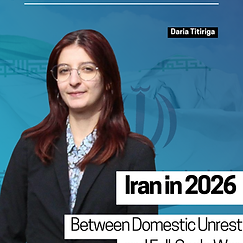
Main question: progress of doemtic unrest and war in Iran
Arguemnts: domestic unrest less important for Iran compared to War
Conclusion: situation needs to be observed as it progresses
MLA
I'm a paragraph. Click here to add your own text and edit me. It's easy.
CHIGACO
I'm a paragraph. Click here to add your own text and edit me. It's easy.
APA
I'm a paragraph. Click here to add your own text and edit me. It's easy.


Iran in 2026: Between Domestic Unrest and Full-Scale War
Domestic unrest
What started as a protest fuelled by economic hardships, domestic unrest in Iran has been on the rise since December 28th, 2025. There are multiple reasons for the economic issues Iran is facing at the moment. As described by Aljazeera, problems started after the short 12-day war Iran fought with Israel in June 2025, resulting in the damage of infrastructure in Iranian cities. This was followed by sanctions on Iran’s nuclear programme being re-imposed by the UN Security Council in September 2025, culminating with rising the price of Iranian petrol and devaluation of Iranian rial adding further financial burden. While all of this is happening, household prices for food are set to increase consuming as much as one-month’s income.
Even so, behind the scene, according to statements of certain experts for DW, the economic crisis was the catalyst rather than the main issue behind the crisis, with protesters attributing the crisis to be a systemic failure of Ayatollah’s regime. Consequently, the protests took a social turn, tackling issues of continuous repression, requesting a political system which respects human rights, demands for democracy and in some cases calling for the restauration of the Pahlavi monarchy, trough Reza Pahlavi. In response to the domestic unrest, the regime answered swiftly and violently between 8 and 9 of January 2026, using firearms and tear gas. During these two days, the country went under internet shutdown, and while official statements placed casualties at 3,117 people, external/independent sources claim that the death toll is as 3,400, 5,000 or even as high as 20,000. In the midst of this all there have been increasing tensions between Iran and the US, which ended up developing in a full-scale war.
War and legal implications
Israel launched a pre-emptive attack on Iran on the morning of 28th of February 2026, which was then followed by the military involvement of the US. The war brought in other countries in the region like Kwait, Saudi Arabia and Bahrain, and it does not seem as if the conflict will stop anytime soon. Five day before, on February 23 the State Department of the US pulled out non-essential government personnel and their families out of its embassy in Beirut (Reuters). On Friday, the US embassy in Israel told its staff they can leave Israel, and if they do so they should do it immediately. A day later the war started.
The legal implications are serious. Under the framework of international law, the attacks were not pre-emptive nor legal. Pre-emptive war does not have a legal basis in international law, and neither of Israel nor the US ware authorised by the UN Security Council (UNSC) to use force. President Trump argued that through the war he also seeks freedom for the Iranian people and when the protests started, encouraged them to take action because “help is on the way”. Even so, a humanitarian intervention with such a purpose - to help the Iranian people - would have also required authorisation from the UNSC. This war brings along concerns around involvement of civilians through violation of international humanitarian law, especially after at least 165 were killed in an unattributed attack on an Iranian girls’ school on Saturday.
So far, the consequences are dire and there are no signs that the conflict will end anytime soon.