
Those who guarantee human rights also guarantee religious freedom.
Papal diplomacy since the Second World War
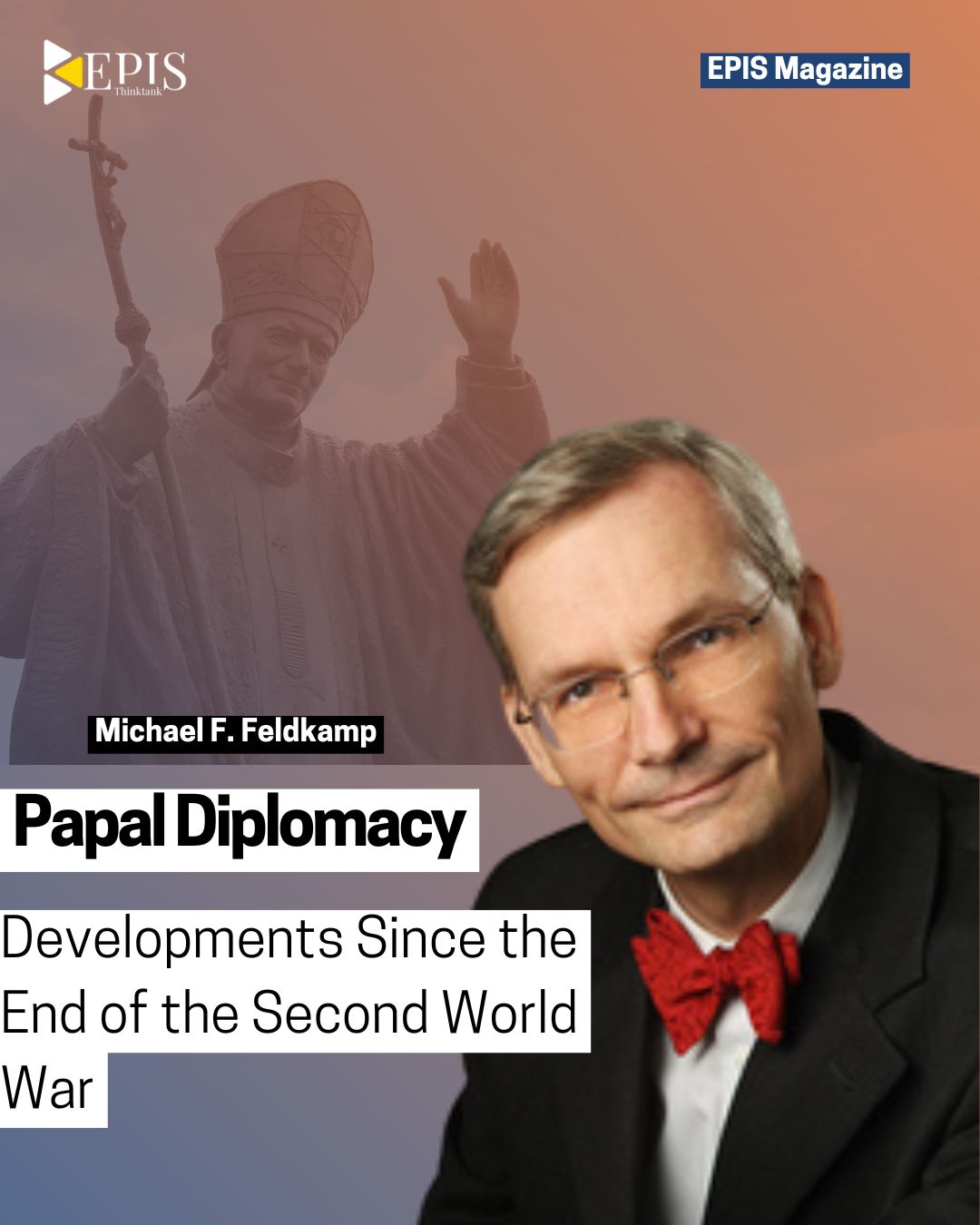
Michael F. Feldkamp, Berlin
Historical development
After the moral, political, and economic destruction of Germany and many other European countries following the Second World War, the Catholic Church—and specifically the Papacy under Pope Pius XII (1939–1958)—was regarded worldwide as one of the few recognized authorities. The Papacy had no proprietary economic interests; it viewed itself as a neutral, supranational actor. Thanks to the Lateran Treaties of 1929, it was financially independent but its currency was tied to the Italian state. This allowed the Holy See to maintain its sovereignty even during the German occupation of Italy. Politically, the Holy See aligned its political interests with the duties and self-understanding of the Pope as the religious head.
On this basis, Pius XII was actively involved in the reconstruction of democratic Western Europe. In addition, he used the early years after the Second World War to establish new diplomatic relations with China (1946), Egypt (1947), Lebanon (1947), India (1948), Indonesia (1950), the Philippines (1951), Pakistan (1952), Japan (1952), Syria (1953), and Iran (1953). These were, until then, countries considered by the Holy See as mission territories under the papal Congregation for the Propagation of the Faith (“de Propaganda Fide”).
Since the 1960s, direct diplomatic relations were established with most independent African states: Senegal in 1961; Burundi and Zaire in 1963; Rwanda in 1964; Zambia and Kenya in 1965; Malawi, Uganda, and Cameroon in 1966; Lesotho, the Central African Republic, and Gabon in 1967; Tanzania in 1968; Ethiopia and Mauritius in 1969; Dahomey and Niger in 1971; and Algeria, Tunisia, Sudan, and Ivory Coast in 1972. By 1972, there were five apostolic delegations and 24 nunciatures on the African continent. Except for Burundi, Rwanda, and Zaire, the Pope appointed pro-nuncios everywhere—i.e., the Holy See waived the precedence of its diplomatic representative within each country’s diplomatic corps. The establishments reflect the Vatican’s growing interest in maintaining diplomatic relations even with countries that have only Catholic minorities.
Moreover, the Holy See maintains representations as a “permanent observer” or “participant” in many international organizations, primarily:
The Holy See has never sought full membership in these organizations. As an observer, it has always participated in political deliberation but has not been part of decision-making and is not accountable for the resulting decisions. This was an expression of its neutrality as a Christian head of state and religious leader. In matters of faith, unlike power politics, compromise is not possible—especially when ethical or moral questions are at stake.
The Papal Ostpolitik – The Pope as a “Global Player”
Since 1973, the Holy See participated with keen interest in the preliminary negotiations for the CSCE (“Conference on Security and Cooperation in Europe”) in Helsinki. From 1975 to 1980, the CSCE constituted the core of a multilateral East-West détente policy in Europe. The participation of Archbishop Agostino Casaroli, the later papal Secretary of State under Pope John Paul II (1978–2005), initially caused astonishment and incomprehension among some diplomats. In doing so, the Vatican intended to use its chances just like the other participating states of the West to advance the policy of détente. The Vatican succeeded in ensuring that the free exercise of religion could be included in the treaty text. Furthermore, Casaroli established unofficial contacts with top politicians of the Eastern Bloc states on the sidelines of the conference, thereby creating the basis for numerous encounters with Eastern European heads of government. Not infrequently, this served to reach an understanding on a “modus vivendi” without truly resolving the problems. But the Holy See became the guardian of the intellectual and moral values in the European culture shaped by Christian values and was significantly involved in the “human dimension” of the future policy of détente.
An unmistakable signal effect and decisive turning point in the Ostpolitik of the Popes came from the unexpected election of the Archbishop of Krakow, Karol Wojtyła, as Pope on October 16, 1978 — an event that was received with ambivalent feelings not only by the communist rulers in Poland. This Pope knew the ecclesiastical and religious circumstances in Eastern Europe from his own experience. It was to be expected that his Ostpolitik would not be made from behind a desk. In 1979, he visited his homeland Poland for the first time as Pope John Paul II. The Slav on the papal throne had sworn the spiritual unity of a Christian West and East Europe as his very own mission.
The contribution of John Paul II to the dissolution of the Soviet Union and thus to the East-West conflict cannot truly be measured as long as this epoch has not been left to historians through the opening of the relevant archives. But through his visits, he ventured a significant building of bridges toward the East.
Since 1989, negotiations with the Holy See have been conducted with all former Eastern Bloc states, including Russia and Ukraine. The trigger was Gorbachev’s visit to the Pope on December 1, 1989. Within two years, all episcopal sees that had remained vacant during communist rule — from Lithuania to Bulgaria and from Belarus to Siberia — could be filled, which undoubtedly posed the highest ecclesiastical-political demands on Vatican diplomacy.
The Vatican’s Ostpolitik did not end with the elimination of the communist dictatorship, but only entered a new phase.
Readjustment since the Second Vatican Council
The Holy See’s diverse diplomatic relations only developed into their present form at the end of the 1960s, that is, after the Second Vatican Council.
Papal diplomacy no longer maintains contact solely with Catholic states, as it did in the past; nor is it limited to dealing exclusively with Catholic affairs. Even during the two World Wars, the Curia did not withdraw from its responsibility for humanity. Its universal (“catholic”) mission was increasingly recognized. Not without reason did states with barely any Catholic population seek to exchange diplomats with the Vatican for historical reasons. Conversely, countries with large Catholic populations — such as Mexico or the United Kingdom — for historical reasons maintain either no or only limited diplomatic contact. Often, they wish to avoid an elevation in the status of the Catholic Church.
Papal diplomacy in the Middle Ages and early modern period was heavily shaped by papal envoys and nuncios, and only since the 20th century increasingly by the popes themselves and their collaborators in the Curia. This is due on the one hand to the greater expansion of the centralized curial administrative apparatus. On the other hand, the world has become much “smaller” in light of media and new means of communication such as telephone, fax, and now the internet. The ability to react quickly to events in the world makes our times fast-moving and often forces political actors to respond immediately.
John Paul II was the first pope to fully take advantage of rapid means of transportation for his pastoral journeys to all continents — more so than any pope before him. His at times spectacular travels are an expression of the desire to be present throughout the world. This presence cannot be replaced by television and other broadcast technologies. Conversely, these stays, declared as “pilgrimages,” do not replace the diplomatic contacts of a papal nuncio. It remains the nuncio’s task to maintain sympathy or at least respect for the Catholic Church among the respective governments, to foster close contact with the bishops, the clergy, and the faithful, and to select suitable candidates for upcoming episcopal appointments. None of this can be carried out by a centralized papal administration in the Vatican; it makes a permanent papal representative indispensable in the ongoing tension between Church and state, as well as between the local Church and the papacy.
Into the 20th century, the popes have built one of the densest diplomatic networks in the world. After the United States of America and the Federal Republic of Germany, the Vatican today maintains the largest number of official diplomatic missions. In contrast to the papal system of legations in the Middle Ages, however, today it is no longer about expanding the worldly power of the popes. Rather, it is Church-related matters that the nuncios represent in individual countries — both among the local bishops’ conferences and in relation to the respective governments.
Models of Church–State Relations
Four different models by which relations between Church and state are maintained across the world and beyond religious boundaries were recently distinguished by Nikola Eterović (The Quiet Power: The Diplomacy of the Holy See, 2023):
Whoever guarantees human rights also guarantees religious freedom
Cardinal Secretary of State Giovanni Battista Montini, the future Paul VI, once described the goal of international papal diplomacy as follows:
“If secular diplomacy strives to unite the world by preferring reason to the use of force and by encouraging individual states to develop within a harmonious community of an ever-expanding international organization, then it finds in ecclesiastical diplomacy almost a model […] because of the ideals from which ecclesiastical diplomacy proceeds and toward which it strives, namely the worldwide, universal community of all people.”
With the retreat of the Church from public life due to modern ideologies — and even more so through the totalitarian states of the 20th century — the humanitarian mission came increasingly into focus for papal diplomacy. Regardless of religion or denomination, papal diplomats have advocated for human and fundamental rights in all countries and international organizations. The core idea is self-evident: a state that guarantees human and fundamental rights also guarantees religious freedom and the free exercise of religion.
That the commitment to a humanely shaped future also includes a political dimension is demonstrated by the engagement of the popes and their diplomats in those countries where human rights and civil liberties are trampled upon.
Documents: 📄 Full Publication (PDF) 📂 Source Document