
LATEST NEWS
Privatizing war
...
...
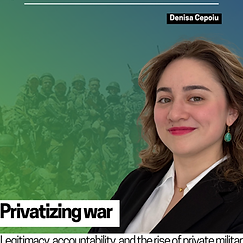
Main question: How have international legal norms adapted to the rise of private military and security companies (PMSCs), and with what consequences for accountability? Argument: States have responded to PMSCs primarily through soft-law mechanisms that normalise private force while avoiding binding legal responsibility. Conclusion: This shift enhances legitimacy and flexibility in security governance but entrenches an accountability gap that weakens international humanitarian law and oversight.
MLA
I'm a paragraph. Click here to add your own text and edit me. It's easy.
CHIGACO
I'm a paragraph. Click here to add your own text and edit me. It's easy.
APA
I'm a paragraph. Click here to add your own text and edit me. It's easy.


Conceptual foundation
Modern private military contractors trace their roots to a historical reconfiguration of warfare due to the decline of state monopolies on violence after the Cold War. As Avant (2007) and Percy (2007) note, the state’s monopoly on violence and armed forces weakened in the 1990s when military downsizing and neoliberal privatisation created both a supply of trained veterans who were open to individual employment and a demand for flexible security solutions that did not fit into the traditional roles and responsibilities of an army. In Russia, for example, parallel developments linked to the post-Soviet security vacuum fostered small military contractors that eventually evolved into the more sophisticated Wagner Group, illustrating how geopolitical and economic shifts jointly generated a “market for force.” Thus, the rise of private military companies can be thought of as the market adaptation of an old practice to the logic of contemporary governance.
The challenge lies in clarifying precisely what constitutes a Private Military and Security Company (PMSC), as this norm is shrouded in definitional ambiguity, which gives rise to legal and ethical disputes. PMSCs are commercial entities providing military and/or security services for remuneration, encompassing activities from training and logistics to direct combat support (Doswald-Beck, 2007). Analysts further divide them into military provider, consulting, and support firms (Mitchell, 2018). This differentiation highlights that not all PMSCs engage in combat; many deliver non-lethal expertise or infrastructure protection. The European policy community even favours the term “Private Security Company” to distance legitimate firms from the “military” and “mercenary” stigma. Nevertheless, the blurred boundary between armed protection and active participation in hostilities ultimately sustains conceptual instability. Hence, because PMSCs’ operational spectrum overlaps with state and army-traditional functions, PMSCs simultaneously challenge and depend on the traditional categories that define lawful force.
However, international humanitarian law (IHL) has struggled to accommodate PMSCs within its binary division of combatants and civilians. The Third Geneva Convention and Additional Protocol I grant combatant and prisoner-of-war status only to those formally belonging to a party’s armed forces, while civilians enjoy protection unless directly participating in hostilities. As Doswald-Beck (2007) explains, most PMSC personnel do not fit within either of these two categories: they are civilians until they engage in hostilities, at which point they may become unlawful combatants. Article 47 of Protocol I defines “mercenaries” through cumulative criteria, which amount to motivation by private gain, recruitment to fight, and exclusion from official forces. Few contractors meet these conditions, yet the normative association with mercenaries persists, generating thus a moral dislike/hesitance towards PMSCs (Percy, 2007). The result is a legal grey zone in which private contractors operate lawfully only by virtue of narrow interpretation.
In response to this legal ambiguity, states and non-state actors alike have pursued a “soft-law” mechanism to lend oversight and legitimacy to private contractors. Lacking consensus on a binding international treaty, regulation has been undertaken by multi-stakeholder initiatives that merge governmental, corporate, and civil society participation. For example, the Montreux Document (2008) articulates existing legal obligations and best practices for contracting, territorial, and home states without creating new law. The International Code of Conduct for Private Security Providers (ICoC) (2010) and its oversight body, the ICoC Association (ICoCA) – of which the United States are a member –institutionalised self-regulation, committing signatory PMSCs to respect human rights and IHL (Mitchell, 2018; Prem, 2021). These frameworks have rebranded the PMSC industry into responsible and legitimate “private security” services. Thus, they have become partially normalised within the global security government.
Moral and normative challenges
The ethical ambiguity around PMSCs, however, persists because they inherit a moral stigma that was historically attached to mercenaries. Historically, the use of violence was a public duty exercised by sovereign-enabled individuals; fighting for pay rather than principle was seen as morally corrupt, thus explaining the emergence of an anti-mercenary norm. Percy (2007) traces this anti-mercenary norm to Enlightenment ideals of civic virtue and national loyalty, which condemned profit-motivated warfare as incompatible with legitimate authority. Although modern PMSCs emphasise professionalism and corporate accountability, they remain entrepreneurs of violence (Percy, 2007), motivated by financial rather than patriotic imperatives. This inherited stigma explains why international debates still equate PMSCs with “dogs of war,” making evident how moral attributions, rather than legal definition alone, sustain a normative unease regarding the privatisation of armed force.
Table 1: Revenues, funding, and notable conflict presence for the three best-known PMSCs.
To overcome their reputational deficit, PMSCs have sought legitimacy through the construction of a professional and legal identity (Mitchell, 2018). Following scandals such as the 2007 Nisour Square massacre by Blackwater (wherein 17 civilians were killed by Blackwater operatives), PMSCs faced intense public backlash. These crises spurred internal reforms, adoption of human rights codes, and participation in initiatives like the ICoC and the Montreux Document (Mitchell, 2018). Through such engagement, PMSCs attempt to project moral rectitude and to rebrand from “mercenaries” to “private professionals,” thus reframing themselves as responsible security providers integrated into global governance.
The central normative problem is that existing accountability mechanisms rely on voluntary compliance rather than enforceable obligations. Prem (2021) describes multi-stakeholder initiatives as arenas of soft-law governance, where rules emerge from negotiation among states, private corporations, and NGOs instead of formal treaties. While these initiatives improve transparency, they reproduce power asymmetries: Western states and Western-based firms dominate the creation of rules and norms, while civil society and Global South perspectives remain marginal. As a result, the regulatory architecture privileges reputational legitimacy over substantive legal control. Doswald-Beck (2007) notes that when PMSCSs violate IHL, either by directly participating in hostilities or by mistreating detainees, responsibility is difficult to assign because states disclaim direct command. Thus, soft-law instruments mitigate reputational risk but fail to ensure legal accountability.
Furthermore, delegating coercive power to private actors risks exacerbating existing conflicts and undermining humanitarian restraint. Empirical research by Lees and Petersohn (2023) shows that state reliance on PMSCs correlates with increased conflict severity, especially when contractors supply rather than merely support regular troops with training. By externalising violence, governments reduce domestic political accountability for casualties and collateral damage. Mitchell (2018) further observes that contractors often operate within ambiguous command chains, complicating investigations into civilian harm. Outsourcing violence, therefore, produces an ethical paradox: while intended to enhance efficiency, it erodes the very norms that underpin humanitarian conduct in war, so proportionality of violence and responsibility.
Lastly, the normalisation of PMSCs signals a broader transformation in global norms governing legitimate force. Normative evolution occurs when repeated practice reshapes expectations about what is lawful or appropriate in international behaviour (Prem, 2021). As PMSCs participate in self-regulatory regimes and state contracts, they acquire a quasi-institutional status within international security governance. Their presence in UN, NATO, and EU operations demonstrates that the privatisation of force has moved from exception to routine. However, this normalisation, achieved through legitimacy-seeking and soft-law coordination, masks the persistence of weak accountability. The moral trajectory of PMSCs thus reflects the ambivalence of the contemporary international order – one that privileges efficiency and flexibility at the expense of the ethical boundaries of warfare.
PMSCs in security sector reforms
PMSCs have become increasingly employed instruments in post-conflict reconstruction in weak states and transitioning states, often supplying the expertise that these states lack. Efforts to rebuild effective, accountable, and democratic security institutions after conflict are all part of security sector reforms (SSR), which are a central part of peace-building strategies. Krahmann (2007) documents how firms (see DynCorp) were contracted in Iraq, Afghanistan, and Liberia to train police and military forces, supply logistics, and rehabilitate defence infrastructure. These private companies filled capacity gaps in the host-state institutions, which were non-functional, with the rapid deployment of trained personnel and technical resources. Their integration within SSR reflected Western priorities for quick stabilisation with minimal national troop commitments. Thus, PMSCs can fulfil the role of pragmatic tools in the implementation of SSR, extending international reach while reducing political and operational costs for donor states.
However, while PMSCs enhance the efficiency of rebuilding efforts, their commercial logic can undermine the long-term legitimacy and sustainability of local security institutions. This is because effective SSR depends on national ownership and public trust; privatisation introduces market incentives that may conflict with these goals. Contractors, motivated by profit and short-term deliverables, often prioritise rapid training outputs over institutional depth (Krahmann, 2007). In Liberia and Afghanistan, for example, externally managed police programs led to dependency on foreign trainers and equipment supplied by PMSCs rather than autonomous, self-sufficient forces. Contracts are given by donors, not by domestic authorities; hence, accountability is a matter of pleasing the sponsors rather than securing the lives of the citizens. The outsourcing of SSR, therefore, risks substituting domestic legitimacy with external capacity, recreating instability once international support ends.
The European Union’s use of PMSCs is an example of the structurally incorporated privatisation of supranational security governance. Bátora and Koníková (2025) describe the EU as an enmeshed security and defence actor, meaning that it fuses public mandates with private implementation networks. In Common Security and Defence Policy (CSDP) missions (see EUBAM Libya), the EU contracts private firms for protection, logistics, and advisory tasks (Bures & Cusumano, 2025). This reliance arises from political and bureaucratic constraints among member states that limit the deployment of EU personnel. Private contractors enable Brussels to sustain missions without full military consensus, but they also obscure lines of accountability since the EU lacks a binding legal regime equivalent to the Montreux Document. Thus, the use of PMSCs by the EU is indicative of a trend within which PMSCs transform from peripheral suppliers to active core operational partners.
Interestingly, the increasing participation of PMSCs in global governance initiatives is leading PMSCs to frame themselves as legitimate partners in SSR and peacebuilding. Mitchell (2018) and Prem (2021) conceptualise this strategy as legitimacy-seeking within multi-stakeholder initiatives (MSIs) that merge state, corporate, and civil-society roles, by signing the ICoC and engaging with the ICoCA, PMSCs posture compliance with humanitarian standards as evidence of corporate responsibility. These initiatives, though voluntary, provide social recognition and contractual advantages in SSR. Participation allows firms to reposition themselves from “mercenaries” to “partners in governance,” influencing how SSR norms are interpreted and applied. In this way, PMSCs manage to capitalise on their ethical vulnerability in order to embed themselves within a new normative oversight framework.
Thus, the challenge for contemporary SSR lies in reconciling its operational utility with the need for democratic oversight. This oversight, especially in the matter of SSR, is constituted through legal responsibility, transparency of contracts, and respect for the host state’s sovereignty. However, states often treat PMSC compliance as a matter of corporate auditing rather than public law (Prem, 2021). Meanwhile, host governments rarely possess the leverage to monitor foreign contractors. The result is what Krahmann (2007) terms “governance without government,” where reform proceeds through private expertise rather than public authority. Hence, sustainable SSR requires moving beyond functional outsourcing toward frameworks that ensure political accountability, integrating PMSCs into the rule of law they help rebuild.
Cases of PMSCSs and their legal applications
Table 2:State employer, country of deployment, and operation type of the three best-known PMSCSs.
EUBAM Libya
The EU’s deployment of PMSCs in Libya demonstrates how international legal norms governing private force are acknowledged in principle but rarely enforced in practice. Under the Montreux Document (2008), states are categorised as contracting, territorial, or home authorities, each bearing obligations to ensure that PMSCs respect international humanitarian and human-rights law. Bures and Cusumano (2025) show that in the EUBAM Libya mission, the EU contracted multiple PMSCs for protection, logistics, and advisory services. Because EU member states have differing national regulations, oversight was fragmented, producing what these two scholars call a “capability–expectation gap.” Similarly, Bátora and Koníková (2025) argue that the EU’s reliance on private actors stems less from efficiency than from an institutional deadlock among member states. Although EU contracts referenced the Montreux principles, no binding enforcement mechanism existed to guarantee compliance. The Libyan case illustrates norm diffusion without enforcement: legal standards are symbolically integrated into the design of the mission but remain functionally voluntary, reflecting the limits of soft-law governance.
Wagner in Syria and Ukraine
Russia’s use of the Wagner Group in Syria and Ukraine exemplifies how states exploit legal ambiguity to conduct hybrid warfare while evading responsibility under international law. This evasion is reminiscent of the concept of “plausible deniability,” which refers to conducting operations in such a way that state involvement cannot be legally attributed. Ashraf and Akram (2024) trace Wagner’s evolution from the Slavonic Corps into a transnational enterprise securing Syrian energy infrastructure through contracts with EvroPolis. The company functions simultaneously as a combat arm and an economic agent, fusing military objectives with profit motives. Rizqulloh and Prawira (2024) document Wagner’s involvement in torture, executions, and indiscriminate attacks in Ukraine, arguing that its personnel meet the legal definition of mercenaries and unlawful combatants. Despite extensive evidence of IHL violations, prosecutions remain absent because attribution to the Russian state is politically contested. Russia’s repeated refusal to legalise PMSCs domestically sustains this ambiguity and allows Moscow to disclaim responsibility for Wagner’s battlefield conduct. Foley and Kaunert (2022) describe this model as hybrid surrogate warfare: private forces operating under informal state direction to achieve strategic goals without formal deployment.
Evolving international legal norms
The rise of PMSCs represents a structural transformation in how international society organises and legitimises the use of force. The post–Cold War environment, characterised by military downsizing, neoliberal privatisation, and global insecurity, generated both the demand for flexible contractors and a supply of professional ex-soldiers (Avant, 2007). PMSCs emerged as market-driven solutions to political and logistical constraints faced by states and international organisations.
The international community’s response to PMSCs has taken the form of normative evolution rather than the creation of binding law. This normative evolution refers to the incremental reinterpretation of existing rules and expectations through practice, without formal treaty amendment (Prem, 2021). Instruments such as the Montreux Document (2008) and the ICoC (2010) codify best practices and ethical standards for both contracting and host states. Mitchell (2018) and Prem (2021) note that these frameworks institutionalise self-regulation but lack enforcement mechanisms. Nonetheless, their adoption signals the growing social recognition of PMSCs as legitimate participants in international security.
However, despite soft-law developments, a persistent accountability gap undermines the effectiveness of international legal norms governing PMSCs. Accountability entails the capacity to identify violations, attribute responsibility, and impose sanctions consistent with IHL (Doswald-Beck, 2007). The case studies confirm this deficit. In Libya, EU oversight relies on contractual compliance rather than judicial enforcement (Bures & Cusumano, 2025). In Syria and Ukraine, Russia’s manipulation of legal ambiguity through the Wagner Group shows how state-proxy relationships exploit the absence of clear attribution rules (Ashraf & Akram, 2024; Rizqulloh & Prawira, 2024). Without binding mechanisms or independent adjudication, the distinction between lawful and unlawful conduct becomes contingent on political expediency. Hence, the persistence of impunity for PMSC abuses underscores that norm creation without enforcement cannot substitute for the rule of law.
The overarching tension in the evolution of PMSC regulation lies between legitimacy and legality. Whereas legitimacy is concerned with social acceptance and normative justification, legality denotes conformity to binding law (Mitchell, 2018). PMSCs have succeeded in achieving legitimacy through participation in multi-stakeholder initiatives and SSR programs, yet legality lags. Their growing institutional role normalises privatised warfare even as formal law remains ambiguous. As Prem (2021) argues, global security governance increasingly operates through “governance without government,” where voluntary compliance substitutes for legal compulsion. The trajectory of PMSCS regulation demonstrates that international law is evolving not by prohibiting private force but by accommodating it. Unless states move from endorsement to enforcement, the governance of PMSCs will continue to present a paradox: legitimate in form, yet legally fragile in substance.
Bibliography
Avant, D. D. (2007). The Market for Force: The Consequences of Privatizing Security. Cambridge: Cambridge University Press.
Ashraf, A., & Hafsa Akram. (2024). “Decoding Operational Latitude of Russian Private Military Companies (PMSCSs): A Case Study of Wagner Group in Syria.” National Journal of International Peace and Security 9 (1): 22–44.
Bátora, J., & Lucia Koníková. (2025). “Private Military and Security Companies and the European Union as an Enmeshed Security Actor.” Journal of Common Market Studies 63 (2): 317–333.
Bures, O., & Eugenio Cusumano. (2025). “Bridging Which Gaps? The European Union’s Use of Private Military and Security Companies in Common Security and Defence Policy Missions.” European Security 34 (1): 1–22.
Doswald-Beck, L. (2007). Private Military Companies under International Humanitarian Law. Geneva: International Committee of the Red Cross.
Foley, F., & Christian Kaunert. (2022). “Russian Private Military and Security Companies and Hybrid Surrogate Warfare.” Central European Journal of International and Security Studies 16 (3): 82–110.
Krahmann, E. (2007). “Security Sector Reform and the Role of Private Military Companies.” Conflict, Security & Development 7 (4): 545–585.
Lees, N., & Ulrich Petersohn. (2023). “To Escalate or Not to Escalate? Private Military and Security Companies and Conflict Severity.” International Studies Quarterly 67 (1): 130–144.
Mitchell, R. (2018). Becoming Legitimate: How PMSCs Are Seeking Legitimacy in the International System. London: Routledge.
Prem, M. (2021). The Regulation of Private Military and Security Companies: Analysing Power in Multi-Stakeholder Initiatives. Berlin: Freie Universität Working Paper Series on Global Governance.
Rizqulloh, D., & Ray Prawira. (2024). “Accountability of Private Military Companies in International Law Violations: A Case Study of the Wagner Group in the Ukraine–Russia Conflict.” Journal of International Law and Global Politics 8 (2): 55–75.
The Montreux Document. 2008. On Pertinent International Legal Obligations and Good Practices for States Related to Operations of Private Military and Security Companies during Armed Conflict. Geneva: Swiss Federal Department of Foreign Affairs and International Committee of the Red Cross.