
LATEST NEWS
Shadows of Hope
...
...

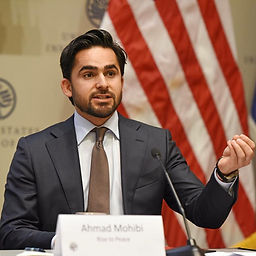
Ahmad Shah Mohibi reflects on his experiences of peacekeeping in the Afghan war. Deriving lessons learned, he takes us through a historical journey with a strong forward-oriented tone.
MLA
I'm a paragraph. Click here to add your own text and edit me. It's easy.
CHIGACO
I'm a paragraph. Click here to add your own text and edit me. It's easy.
APA
I'm a paragraph. Click here to add your own text and edit me. It's easy.

Shadows of Hope: Reflections on Afghan Peacekeeping
By Ahmad Shah Mohibi, Founder, Rise to Peace / Co-Written with Etienne Darcas, Media and Terror Lead, Rise to Peace
In Afghanistan, peace has always been an elusive dream, chased through decades of conflict, foreign intervention, and internal fragmentation. My life, from the battlefields of my childhood to the negotiation rooms of my adulthood, has been defined by this relentless pursuit of stability and peace, so that others wouldn’t need to face the same pain that I and so many others had to. Yet, standing now at a distance, as both an Afghan and an American citizen, I recognize with painful clarity how our shared aspirations for peace have repeatedly dissolved amid broken promises and strategic miscalculations.
Growing up during the bitter Afghan civil war, I never knew peace. My earliest memories are punctuated by explosions and gunfire. Violence reigned in the chaos of the Soviet withdrawal in 1989 and the economy collapsed. Some of my earliest memories were of working the poppy fields in the only viable large-scale industry available to Afghanistan at that time – opium production. Then 9/11 happened, and I, just a boy of 15, was transfixed by the horror of those people falling from the burning towers. The Americans came and quickly everything changed, or so it seemed at first. At sixteen, with few options available, I joined American forces not out of ideological conviction, but from a simple instinct for survival and a desire for change. Fighting alongside U.S. troops, I quickly learned how deeply complicated Afghanistan's reality was. We were a mosaic of tribes, ethnicities, and loyalties, resistant to any simplistic imposition of order from the outside. Eventually, I’d even be invited to go to America – a dream which had always seemed impossible to imagine.
My journey to America was more than physical; it was transformative, providing me a lens through which I would forever see my homeland differently. Becoming American meant more than obtaining a passport; it represented the realization of freedoms that had been unimaginable to a young boy accustomed to perpetual violence. America embodied something precious yet intangible: hope, stability, and the opportunity for a life defined by possibilities rather than limitations. This was still the American century. But witnessing Afghanistan’s peacekeeping efforts from this newfound vantage point also highlighted the disconnect between noble intentions and the gritty realities of a nation fractured by war.
From the Bonn Agreement of 2001 to the Doha negotiations nearly two decades later, each diplomatic breakthrough carried seeds of its eventual unravelling. The Bonn Agreement itself, hailed as historic, excluded the Taliban from initial discussions, alienating a fundamental pillar of Afghan society and laying the foundation for perpetual insurgency. Similarly, the provisional government installed at Bonn, under Hamid Karzai, was inherently compromised, dependent on warlords whose support came at the cost of corruption and abuse of power. In enabling this outcome, Western forces inadvertently ensured that not only would the new Karzai government have a new, permanent foe who would regroup in Pakistan’s friendly, Pashtun tribal regions and strike back in due course, but its political longevity relied on diminishing returns because of having to keep the powerful factions of Afghanistan on side – diminishing returns that would continuously erode Kabul’s centralising ambitions
International peacekeeping missions, notably the International Security Assistance Force (ISAF) and later NATO’s Resolute Support Mission, arrived with admirable objectives: security, stabilization, and state-building. Yet these missions often ignored the intricate social and political landscape of Afghanistan, adopting centralized solutions designed in foreign capitals. The emphasis on military solutions frequently overshadowed political reconciliation, fostering resentment among local populations who saw foreign troops as occupiers rather than liberators. Each drone strike, each military raid, reinforced Taliban narratives and boosted recruitment, deepening distrust in government forces and Western allies. We entered a vicious cycle of action and reaction, of recriminations, until nobody could trust each other at all.
Negotiations themselves suffered from a lack of genuine leverage on Kabul’s part. In Doha, the Taliban presented themselves as unified and confident, whereas Kabul’s delegation, fractured by internal factionalism, electoral disputes, and pervasive corruption, struggled to present a coherent stance. The U.S.-Taliban agreement of February 2020 further undermined Kabul by effectively treating the Taliban as equal partners, sidelining the Afghan government entirely and signalling to the Afghan populace that their government lacked true sovereignty.
Implementation failures compounded strategic errors. Temporary ceasefires were routinely announced to international applause, only to collapse shortly thereafter. Disarmament, Demobilization, and Reintegration (DDR) programs became ineffective as former fighters frequently returned to insurgency or crime due to inadequate support or oversight. Moreover, aid and military support funnelled into the country became a source of corruption rather than stability, as exemplified by the Kabul Bank scandal of 2010, where $1.3 billion of ordinary Afghans' savings vanished into the pockets of elites closely connected to the government. Such a case would symbolize the pervasive corruption and impunity that have threatened the legitimacy of the Afghan government, as it highlighted how the average Afghan, trying their best to save up and invest, could easily have their earnings siphoned away in an unaccountable system by those who seemed to be hoarding international resources. By empowering kleptocratic actors within government, flooding resources into the country with little oversight and not only failing to enfranchise the man on the Afghan street, but disenfranchising him actively, was such a dysfunctional system born that fed on its own neglect and corruption
These systematic failures, especially the neglect of genuine local ownership, significantly eroded trust in government institutions. Western assumptions about Afghan civil society frequently overlooked its robust traditional frameworks such as tribal councils and jirgas, which were vital in maintaining local governance and resolving conflicts. Instead, foreign aid often bypassed these traditional structures, fuelling corruption among centralized authorities in Kabul and exacerbating regional tensions. In this, Western assumptions about the actual strength of Afghan civil society proved to be ignorant – us Afghans have an extraordinarily powerful civil society, but it operates according to an internal social logic. Our society is not a Western one – we do not have an intelligentsia, backed up by a higher education system. What we have, though, is each other. The tribe, our tribe, with all its manifold and conflicting manifestations. To the Afghan on the street, the Loya Jirga process is sacred, and couldn’t be substituted for a central government in Kabul. Going against this process was akin to a patient with an auto-immune disorder in their body-politic; deadly to outsiders, but liable to be turned against itself because of the tensions between the centralising model of government of Kabul, and the desire for autonomy in the provinces. This was a lesson learned far too late in the peacekeeping process when it was too difficult to turn back from the government that Karzai had come to represent.
The Afghan National Army (ANA), intended as the backbone of national security, reflected these broader issues of governance and corruption. Despite international training and immense investment, ANA forces were plagued by endemic issues, including "ghost soldiers" whose salaries enriched corrupt commanders, undermining morale and effectiveness. By 2021, when the Taliban launched their final offensive, ANA forces, inadequately supplied and increasingly demoralized, swiftly collapsed.
Despite this dysfunction, Afghan civil society demonstrated remarkable resilience. Educators continued teaching, journalists bravely reported truths, and activists tirelessly advocated for human rights, defying threats and violence from the ruling Taliban. Their determination underscored an essential truth: genuine peace must be cultivated from within, supported rather than dictated by international actors. For all the failures of the Afghan peace-keeping process, we Afghans can take pride in the resistance of regular people to the return of Taliban rule.
Becoming an American citizen deepened my appreciation for the freedoms Afghans continued fighting for: basic rights, human dignity, and accountable governance. Yet, witnessing the chaotic U.S. withdrawal in August 2021, I felt a profound disillusionment. It was almost a sense of betrayal of those shared values. As the Taliban swiftly reclaimed power, tens of thousands of Afghans desperately sought to flee, clinging to departing U.S. aircraft in haunting scenes reminiscent of those falling people from 9/11. These images encapsulated the tragedy of lost opportunities and broken promises. Of a lost home, and of a new home, far away from the chaos and violence of the Afghanistan of my birth – An America that may not always succeed at holding up its values of peace and liberty for all, but nonetheless is an attempt at something greater than the sum of its parts.
The lessons of Afghanistan demand honest reflection. International actors must admit strategic missteps and re-evaluate engagement practices in fragile states. Peace cannot be time-bound nor imposed externally; it demands patient, sustained commitment rooted in genuine understanding of local realities. Protection for the vulnerable, particularly women, children, and minorities, must be prioritized, alongside support for grassroots mechanisms like jirgas, which have proven resilient through decades of conflict.
My dual identity as Afghan and American reinforces my belief in bridging divides and fostering dialogue. As founder of Rise to Peace, I remain committed to advocating tirelessly for genuine solutions that recognize the complexities and potential of Afghanistan's own civil society. Afghanistan’s painful history offers critical lessons for future international engagement, reminding us that real peace emerges organically, shaped by the hands of those it directly affects.