
LATEST NEWS
Sino-Japanese Diplomatic Clash
...
...
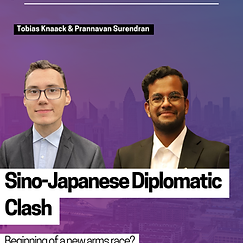
- Does Takaichi's remarks on Taiwan cause a new arms race between China and Japan
- No acceleration of military build up has been observed
- the fear of a new arms race did not come into reality
MLA
I'm a paragraph. Click here to add your own text and edit me. It's easy.
CHIGACO
I'm a paragraph. Click here to add your own text and edit me. It's easy.
APA
I'm a paragraph. Click here to add your own text and edit me. It's easy.


Sino-Japanese Diplomatic Clash
Beginning of a New Arms Race?
The geopolitical sphere in East and Southeast Asia is confronted by China’s growing influence and military assertiveness. Hybrid Warfare and Grey-Zone Activities in the South China Sea pose a serious threat to the surrounding countries. Notably, Xi Jinping’s aim to reunite Mainland China with the “renegade province” of Taiwan by force paves the way for a possible conflict in the near future. The so-called Davidson Window estimates a timeframe until 2027, where military analysts suggest a violent Chinese takeover of Taiwan. It affects US strategic planning and is key to the US-China great power competition. However, not only does the US show interest in deterring China from invading Taiwan, but Japan has also shown increasing efforts in strengthening its position to support Taiwan. Shinzo Abe, the late Prime Minister of Japan, has introduced measures to counter Chinese influence and has supported Taiwan. After leaving office in 2020, he has been vocal about a Chinese military action against Taiwan being classified as an emergency situation for Japan.
On 7 November 2025, Takaichi Sanae, the newly elected Prime Minister of Japan, said during deliberations of the National Diet that a Chinese forceful approach towards a reunification with Taiwan could constitute a situation threatening Japan’s survival. The comments sparked outrage from Chinese officials. The Chinese consul general of Osaka reacted with a controversial post on a significant social media platform. Takaichi’s remarks and the post, later deleted after a protest from the Japanese government, triggered diplomatic tensions between China and Japan. China has asked Takichi to retract her statement, but she remained firm on her position weeks later. On 17 November, Japan sent the director general of the Foreign Ministry’s Asia and Oceania bureau, Masaaki Kanai, to clarify Takaichi’s remarks, but was unsuccessful. Since then, diplomatic efforts have not eased tensions.
Chinese retaliatory measures have included coast guard activities around the disputed Senkaku Islands, which both nations claim, the interruption of concerts by Japanese artists, and warnings for Chinese citizens to avoid travelling to Japan. On December 6, Chinese military aircraft temporarily locked their fire-control radar onto Japanese fighter jets that had taken off to monitor a large-scale exercise involving the Chinese aircraft carrier off the southern Okinawa Islands. Additionally, China has attacked Japan’s bid for a seat in the UN Security Council and called Japan unqualified for that.
Takaichi, who is prominent for her hawkish foreign and security policy agenda, including the revision of the key three strategic documents, the National Security Strategy, the National Defense Strategy and the Defense Buildup Program, has been pushing towards a tougher stance towards China. With diplomatic tensions still on the rise, the question arises whether the crisis will trigger further action and lead to a military buildup on both sides.
2. Chinese Military Reaction
Generally, the People’s Republic of China is known for using its economic power to navigate through international turbulences. Nevertheless, since the official stance of the Chinese Government is that Taiwan belongs to China, the Taiwan issue is a domestic topic, and Japanese intervention is considered a foreign military threat, which China views as a threat to sovereignty. The Chinese Communist Party has also used military pressure throughout the last three months, until January 2026.
In November 2025, the Chinese Government continued to use diplomatic and economic means to deter Japan from considering interfering in the Taiwan Issue. Security measures for China’s own citizens have been put in place. On 14 November, the Chinese Government issued a travel warning to all Chinese citizens, advising them not to travel to Japan.
At the same time, the first direct encounters began near the Diaoyu-Dao Islands, which are currently under Japan's administration as the Senkaku Islands. Those islands in the East China Sea have been disputed for years. Amid rising diplomatic tensions, China has increased its coast guard presence around the islands to enforce its claims. This prompted a reaction from Japan, which sought to maintain its control over the Islands.
This comes shortly after the PLA-Navy introduced the new Fujian Aircraft Carrier in early November. According to military experts, China's goal is to expand its fleet to 9 Aircraft Carriers by 2035 to create a blue-water navy that could also be used in the eastern Pacific. For Japan and its allies, this process can become problematic if the region further militarises. However, for China’s fleet, it should be noted that this new aircraft carrier has not been developed spontaneously, as construction takes time. The creation of a bluewater navy has been a long-term goal for the Chinese Government, not a spontaneous idea to counter Japan.
From early December 2025, military tension between the two countries rose sharply, beginning on 6 December. On that day, Chinese fighter Jets encountered the air forces of the Japanese Defence Forces. During that incident it also became clear that the Chinese Fighter Jets locked their fire control radar onto Japanese forces. Those radars are usually used to assist in targeting enemy air forces. Until now, both sides have been blaming each other for this incident. Japan claims that this is interpreted as a Chinese act of aggression against Japanese air patrols. The Chinese side, on the other hand, claims that the PLA-Air Force's manoeuvres were part of a military exercise in the East China Sea, which Japan was supposedly warned of beforehand.
After that, military tension did not ease as Chinese and Russian air forces conducted further exercises, with their routes stretching across the Sea of Japan and the East China Sea, and even over Japan. Those exercises were conducted between 9 and 10 December, only a few days after the fire-control radar accident.
It can be argued that the direct use of military tension has been brought up after Japan announced the stationing of rockets near Taiwan at the end of November. Seeing Japan turn from rhetoric to mobilising hard power near Taiwan, the Chinese government was probably forced into action, shifting from diplomatic and economic pressure to demonstrating its own hard power to deter Japan.
After those events, it became public on 22 December that two PLA commanders, who had previously served as commanders of units responsible for Beijing and the Taiwan Strait, had been promoted to the rank of general. Also, the Chinese Government declared the eastern theatre its most crucial military theatre. Most likely, the Chinese Government is emphasising this to convey the greater importance of the new tensions over the Taiwan issue compared to other conflicts. Regarding the promotion of the two PLA commanders to generals, it is hard to determine whether this is really about the current tension with Japan or rather about a broader restructuring within the Chinese military's top ranks. That has been its own process for a long time, and it recently reached its peak with the custody of Zhang Youxia.
From 29 to 30 December 2025, China's military exercise “Mission Justice 2025” took place. This was a giant military exercise aimed at simulating a full blockade of Taiwan. Meanwhile, the military exercise also sought legitimisation by demonstrating the PLA's power and deterring foreign interference, for instance, from Japan.
As before, it needs to be estimated that such an exercise has not been spontaneously staged and prepared in less than 2 months. Instead, the exercise might have been planned long ago, as China has been preparing for unification with Taiwan for decades. This makes the exercise a good rhetorical and military tool of deterrence, whose results and demonstrated capabilities are nonetheless a significant issue for the West. But still, it is most probably not a direct result of the current diplomatic clash.
By January 2026, probably after seeing that Japan will not back away from Takaichi's statement, and amid concerns over tight US-Japan ties in a possible escalation, China will have mostly returned to trade and economic pressure.
On 6 January, the Chinese Government announced a ban on dual-use goods that might be used for its military buildup. Most importantly, there are rare earth elements and drone components. Those have actually proven to be effective measures, as many Japanese producers depend on those Chinese exports reaching their manufacturers. This move marks a return by the Chinese Government from military pressure to weaponising its trade structures and economy in foreign policy.
Besides that, up until the moment of writing, no extraordinary military clashes have been recorded. It could be argued that the Chinese Side is in a process of military buildup and modernisation. But this is a process that has been going on for decades by now, and there have been no hints that the current tensions have led to a notable increase in the production of military goods or in recruitment. Also, patrolling throughout the disputed Islands has already been high for years, making it hard to detect any drastic change in Chinese politics. The only factor that is still important is that the amount of anti-Japanese rhetoric in Chinese media has peaked, referring to the Japanese defeat during World War II and a "repetition of history”.
Alongside the restriction of cultural programmes, this may indicate an effort to shape public perceptions that normalise a more confrontational narrative of Japan as an enemy and potential future military rival.
In sum, it has to be said that China did not really embark on a “new” military buildup. Instead, its military buildup, modernisation, and restructuring have already been underway for years. What actually happened was that China tried to exercise military deterrence through military exercises and by shaping its surrounding rhetoric to make processes already underway fit the current environment. But in the end, China resumed using its diplomatic weight in organisations like the UN and its economic power to put pressure on Japan while continuing its current pace of military build-up.
3. Japanese military buildup
In the same month of Takaichi’s remarks on Taiwan, the Japanese Defense Minister Shinjiro Koizumi confirmed the plans to deploy medium-range surface-to-air missiles on the exposed Japanese island of Yonaguni, which is located only 110 kilometres away from the Taiwanese coast. Koizumi argued that deploying missiles would strengthen Japan's defence, signal readiness, and deter. China has criticised the decision as a deliberate attempt to create regional tensions and provoke military confrontation. Yonaguni carries strategic importance and value as it lies within the First Island Chain, which constrains Chinese access to the Indo-Pacific.
At the end of 2025, Japan’s Cabinet approved a record defence budget for the fiscal year of 2026. The budget sets a record of around 9 trillion Japanese yen. Japan aims to increase burden-sharing with the US and to achieve a defence budget equal to 2 per cent of its GDP. The plan is further evidence of Japan accelerating its security policy realignment that was triggered after the Russian attack on Ukraine in 2022. The Japanese Self Defense Forces are further expanding their capabilities and are moving toward significantly increased defence spending at around two per cent of the GDP. A key development is expanding stand-off capabilities through procurement and development of long-range precision weapons. Japan is keen on strengthening its ability to deter attacks at an early stage and to respond to emergencies caused by a Taiwan contingency or North Korean missile attacks. Integrated air and missile defence, along with additional necessary sensor and command infrastructure, is further enhanced. The budget promotes cross-domain operational capability of the Self-Defense Forces. The Japanese Defence Ministry is shifting its focus to investments in space, cyber, the electromagnetic spectrum, and unmanned systems such as drones and unmanned sea and underwater vehicles. Latter are specifically essential for protecting underwater infrastructure such as fibre-optic cables, power cables, and pipelines for energy and data. Japan is focusing on securing maritime access routes.
The budget supports reforms to the Self-Defense Forces, ranging from improvements in joint command and operational structures to measures to increase military mobility and responsiveness. As Japan faces severe demographic challenges, efforts are underway to increase investment in recruitment and improve working conditions. Creating industrial resilience, securing essential supply chains and enhancing Japan’s role in international defence cooperation. The 2026 budget contributes to a continuous strengthening of the Japanese Self-Defense Forces. It underscores Japan’s ambition to position itself as a reliable and strategically important partner in the tense security environment of East Asia and Indo-Pacific.
Already in October 2025, during Donald Trump’s visit to Japan, Prime Minister Sanae Takichi underscored the importance of the security alliance with the US and continued the course to reinforce Japan’s defence capabilities that began during the tenure of late Shinzo Abe.
The ongoing military buildup is not a reaction to a Chinese economic intimidation attempt or any other means. It is simply the continuation of Japanese efforts to influence geopolitical events in its environment.
4. Conclusion
In conclusion, both sides appear to be engaged in a military buildup, though not as expected following the most recent diplomatic clash between the two powers. In Japan, the current army buildup has already accelerated since the war in Ukraine began, to prepare for potentially escalating conflicts.
On the Chinese side, military modernisation has been a significant goal for the Chinese government for decades, as it prepares for multiple potential conflicts across its vast borders and maritime disputes. Also, the restructuring of their military personnel amongst their generals, as well as the CMC, intensified further after Xi Jinping came into power.
A real-time reaction to the tensions might include incidents in the East China Sea involving Chinese and Japanese Fighter Jets, as well as Chinese-Russian military exercises over Japanese airspace. But those are rather provocations, probably meant to deter Japan from further radicalising its rhetoric on Taiwan. On the Japanese side, an action that might be seen as a more or less direct response could be the deployment of Japanese missiles near the Taiwanese mainland. But those actions remained the only military actions within their diplomatic clash. Therefore, it is not to be expected that either Japan or China are preparing for a near-term war over Takaichi's remarks.
Despite this, the situation remains tense, as China, backing down from military provocation, has started using its economic weight to counter Japan's ongoing military buildup without risking the outbreak of a hot war. Therefore, diplomatic and economic conflicts might be better avoided than an intense acceleration of the military arms race.