
LATEST NEWS
Uniting technology partnerships with outer space
...
...
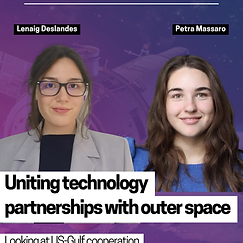
1. Can economic partnerships between the US and Gulf states based on technological exchange be broadened to incorporate space technologies and joint strategy? 2. There are already several joint partnerships and ventures between the parties emphasising space defence, technological interoperability, etc. 3. The main challenge remains in terms of ensuring national security interests are met when developing these partnerships. For the US, this also means avoiding China
MLA
I'm a paragraph. Click here to add your own text and edit me. It's easy.
CHIGACO
I'm a paragraph. Click here to add your own text and edit me. It's easy.
APA
I'm a paragraph. Click here to add your own text and edit me. It's easy.


Uniting technology partnerships with outer space: Looking at US-Gulf cooperation
US-Gulf Economic Cooperation
The Gulf states have come forth as a key domain for US investments in future technologies. Amidst US President Trump’s controversial America First economic policies, US allies and China suffered the most from the US’s retrenchment, while Gulf states enjoyed an uncharacteristic strengthening of technology, energy, and security partnerships. In his State of the Union speech, Trump declared an economic “turnaround for the ages”, looking back on previous administrations and showcasing his economic plans for the future.
A key marker of his economic achievements is his May 2025 tour across Gulf states, which included Saudi Arabia, Qatar, and the United Arab Emirates (UAE). He secured a significant $2 trillion in investment deals, heralded as breakthroughs for the innovation and development sectors in the US. While Trump has enjoyed a little over a year in office, translating these deals into results will be key for the rest of his term, a part of a broader strategy to box out competitors like China. Thus far, US interests in the Gulf have been largely focused on the long-term, pushing for deeper future industrial and economic engagement from both parties.
Commercial deals between the US and Gulf states often advance market access. American exporters are largely concerned with national security, whereas Gulf nations tend to favour economic benefits. For example, significant deals exist between the US and the UAE on aerospace and commercial aviation: this bolsters the US critical mineral supply chain and domestic manufacturing, but also drives UAE oil and gas production. Progress has also been made between the two concerning the AI industry. Supporting the UAE’s digital transformation meant the US could build a deal promoting advanced connectivity, edge AI, and cloud computing networks, namely through the building of data and research centres. National security clauses were included in the partnership, guaranteeing that US competitors would not be involved. These deals lay the basis for investment, joint trade, innovation, and job creation, highlighting a strategic partnership focusing on the next technologies (aerospace, AI, energy, and critical minerals).
Indeed, US partnerships with Gulf states have shifted to include defence and security characteristics. In November 2025, the Saudi crown prince agreed to increase US investments by nearly $400 billion. In a time of tense geopolitics, the deal focused on military procurement, AI, and liquefied natural gas. Advanced and future-oriented technologies are now prioritised in terms of national security directives. AI partnerships are secured for security cooperation and intelligence sharing purposes. With the outbreak of a US-Israeli war on Iran and Iran’s retaliatory strikes on its neighbours and US allies, securing the region has become a priority. For the US, this appears as the need to maintain a US-led regional order and to bar China from accessing industries critical to national interests. Nonetheless, the more discreet yet increasingly pertinent subject of space technologies and cooperation has also been affected by securitisation policies. As the following section will examine, space cooperation is subject to strategic defence and collaboration partnerships, a strategy similar to the one adopted for “new tech”.
Space Cooperation
Space cooperation is a key element of the developing US-Gulf strategic collaboration, reflecting Washington's larger reorientation of Middle East policy toward interoperability, burden-sharing, and technology alignment.
Particularly regarding the missile defence infrastructure around the Gulf, US policymakers increasingly view space as an enabling layer for integrated deterrence rather than as a supplementary civil realm. The push to network US-supplied air and missile defence systems, which are currently deployed in neutralising Iranian ballistic and cruise missile threats, requires resilient space-based early warning, positioning, and command-and-control infrastructure.
At the same time, partnerships encourage significant commercial and industrial collaborations. Gulf procurement and capital inflows assist major US aerospace primes and NewSpace companies, while Riyadh and Abu Dhabi's sovereign wealth funds serve as financial accelerators for Western space businesses looking to expand. This industrial logic is linked to great-power competition. On the one hand, Washington restricts the transfer of sensitive technologies through regulatory tools like the International Traffic in Arms Regulations (ITAR); on the other, Gulf alliances are discouraged from interacting with Russia or China. The result is a covert attempt to maintain the Gulf states' integration into an orbital environment headed by the United States. At the same time, high-visibility missions, most notably the UAE’s Hope Probe to Mars, serve to project images of modernity and innovation while reinforcing alignment with Western space norms. These types of relationships are increasingly defined by official US terminology as structural and security-oriented, highlighting a shift from ad hoc civil collaboration to defence-linked interoperability.
A network of bilateral and international frameworks that codify adherence to US-led governance standards serves as the institutional foundation for this convergence. The most prominent platform is the Artemis Accords, which were signed by the United Arab Emirates in 2020 and later joined by Saudi Arabia, Bahrain, and Oman. They signify a commitment to responsible lunar exploration, transparency, and interoperability. Regarding the promotion of bilateral defence, an example can be found both in the US-UAE Defence Cooperation Agreement of 2019 and the 2024 extension of civil frameworks between NASA and Saudi authorities. In a setting where "Major Non-NATO Allies" are integrated into a broader security framework that leverages commercial space resources to boost collective resilience, NATO's new Commercial Space Strategy would transcend bilateralism. This way, purchases of launch services, satellite platforms, and astronaut training, engagements that started off as primarily transactional, have grown more structural. Joint ventures such as Orbitworks and the UAE’s contribution of an airlock to NASA’s Lunar Gateway illustrate movement toward co-development. In order to lessen reliance on direct US operational supervision, defence cooperation is also expanding into sensitive areas, such as the transfer of ballistic missile early warning satellites to regional allies.
This transition from the role of end-use to partial ownership of technologically advanced assets can be observed in the Gulf's capacity accumulation. Oman's Etlaq Spaceport hopes to build the first commercial launch facility in the Middle East by 2027, while the majority of states continue to rely on international launch providers. Localisation trends are more pronounced in satellite manufacturing: the UAE’s MBZ-SAT was reportedly 90% manufactured domestically, and Orbitworks represents the region’s first commercial mass-manufacturing plant for small satellites. Saudi Arabia’s Neo Space Group is pursuing end-to-end portfolios through acquisitions and venture investments. Nevertheless, asymmetries persist. Gulf actors lack heavy-lift launch vehicles and certain advanced ISR capabilities, and ITAR restrictions function as chokepoints limiting the depth of technology transfer - illustrated when an Emirati rover was prevented from launching on a Chinese mission due to embedded sensitive components. Technology governance thus doubles as geopolitical boundary-setting.
China’s role intensifies these dynamics. Washington worries that if Gulf security space requirements are not met, Beijing or Moscow could come in to fill the gap. Gulf governments, especially Saudi Arabia and the United Arab Emirates, engage in hedging tactics by continuing to participate in the Sino-Russian International Lunar Research Station effort and the US-led Artemis framework. While Oman continues training exchanges, China has increased its presence through joint R&D facilities in Abu Dhabi and technical talks with Saudi Arabia for satellite software transfer. The main goal of US regulatory pressure measures is to restrain deep Chinese integration without undermining Gulf autonomy.
The civil-military distinction is correspondingly blurred. High-resolution Earth observation platforms such as KhalifaSat and MBZ-SAT, while publicly framed as civil assets, offer strategic ISR advantages in regional disputes. Demand for sovereign missile tracking and reconnaissance capabilities is rising, and the integration of commercial solutions into NATO and US Space Force initiatives supports distributed deterrence. Economically, the model is hybrid: state-backed sovereign wealth funds (including Saudi Arabia’s Public Investment Fund and the UAE’s Mubadala) pair with private-sector ventures to localise high-tech manufacturing and stimulate diversification under national transformation agendas such as Saudi Vision 2030. Lastly, the degree of alignment points to institutionalisation as opposed to sporadic collaboration. By integrating Gulf partners into operational planning and exercises, US Space Forces Central's presence at Al-Udeid Air Base strengthens a long-standing, security-driven alliance that is becoming more and more resilient to political upheaval in Washington.
Foresight
Nurturing economic partnerships between the US and its partner Gulf nations will be essential in generating jobs in manufacturing, defence, and technology, and stimulating mutual growth. Future-oriented industries like the space sector could bring in even more growth, bolstering the economies in the long-term and ensuring global competitiveness in an increasingly coveted domain. However, while the US actively seeks out deals with Gulf players, it does not necessarily mean they have deprioritised China as a major trade partner. Relations with China often transpire in terms of technology, education, green energy, health, and tourism. Gulf nations such as Saudi Arabia have already pledged to contribute to China’s Tiangong station, specifically in scientific research. In the long-term, US companies will need to manage relations and assess opportunities carefully as Gulf states seek deeper ties with their direct competitors in a new age of space competition. Technology-exchange deals had already been waylaid due to weak regulatory structures, potentially allowing China to access sensitive US intellectual property. At a time when space technologies are critical to national interests, China’s growing influence in the region can lead the US government to impose further blocks on technologies deemed “critical” or “dual-use”. Future economic and financial interests in the Gulf in the space domain are likely to be heavily influenced by domestic US policy and security goals. For the Gulf nations, technology-oriented investments are favourable, as they often participate in rebalancing and diversifying their trading relationships and economies.