

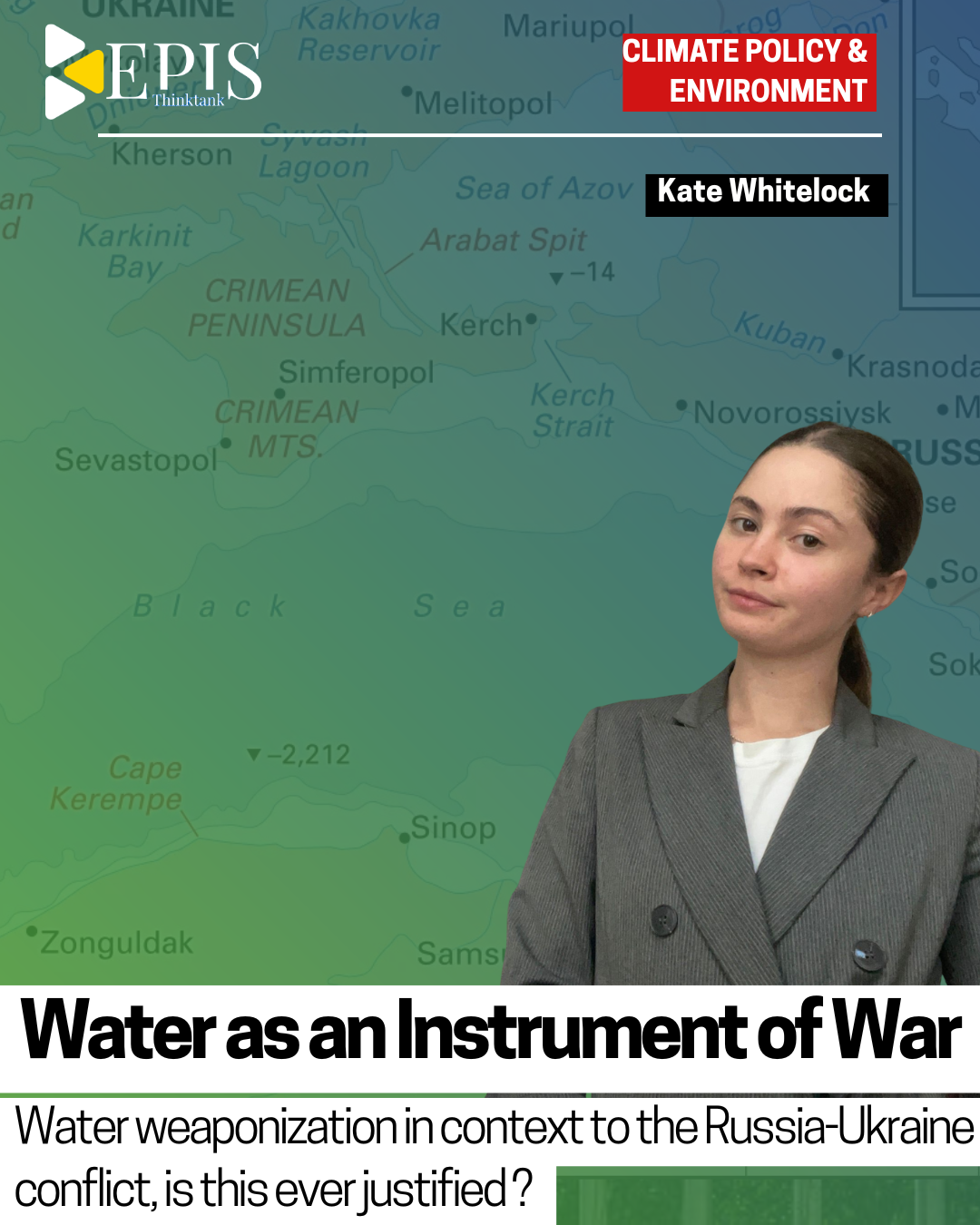
Green Criminology = an attempt to bring legal and political justice for ‘ecocide’ in conflicts.
Water as an Instrument of War
Water is a finite resource, due to the world’s growing population and anthropogenic climatic change which means that the demand for water is growing, whilst at the same time being unevenly distributed. Water scarcity hits the developing world, particularly women and girls, the hardest as, for many, it means more laborious time-consuming water collection. According to the World Health Organization (2025), one in four lack access to clean drinking water. So, Goal 6 of the Sustainable Development Goals (SDGs) ‘ensure availability and sustainable management of water and sanitation for all’ (United Nations, 2025) in 2030 is becoming ever more out of reach.
When we bring in weaponization of water into the conversation on water scarcity, this increases the disparity, even further, of access to water and sanitation for all. To weaponize water, in war, means to use it as a strategic instrument as ‘a means of gaining advantage or defending oneself in a conflict or contest […,] an item, action, offensive capability, or mechanism used or intended to kill, injure, or coerce’ (King, 2016, p.155). In a study assessing the problem of weaponizing water in war in Africa and the Middle East, Marcus King developed a six-category matrix of how water is used as an instrument. (King, 2023, p.2).
Water weaponization is nothing new to conflict and cooperation, ‘in ancient Mesopotamia, a conflict over the Euphrates River between two Sumerian cities yielded the world’s first recorded treaty’ (Daoudy, 2020, p1349). In the Russia-Ukraine conflict, water has been a central instrument used by both sides primarily used tactically and strategically, however, instances of water weaponization never pertains to just one category within the matrix.
Whilst water weaponization is nothing new in war, contemporary conflict has seen an increase of attacks on water infrastructure as it becomes a sparse resource. During the Russia-Ukraine conflict, one of the most significant incidents to water infrastructure was the destruction of the Nova Kakhovka Dam on the Dnipro river in 2023 caused by an explosion forcing it to collapse, which affected the Kherson region and the Crimean peninsula. The critical infrastructure that was destroyed was labelled as ‘ecocide’ by President Volodymyr Zelensky (Dannenbaum, 2023) due to the ecological and humanitarian disaster it caused. Ukraine declared a state of emergency in Nova Kakhovka, a post-soviet area. Nova Kakhovka Dam was under Russian military control, however, supplied water to the irrigation system of Southern Ukraine as well as cooling the Zaporizhzhia nuclear power plant, the largest power plant in Europe.
Both Ukraine and Russia placed blame for this destruction on each other, President Zelensky condemning ‘Russian terrorists’ (Financieras, 2023, p.1) and Russia claimed that Ukraine sabotaged the dam themselves. However, evidence clearly suggests that the dam was destroyed by those that controlled it – Russia. Moreover, in late 2022 Russia began to deliberately drain the Kakhovka reservoir likely to hinder Ukraine’s agricultural production. Ukraine is categorized as ‘the breadbasket of Europe’ (FOA, 2022) due to certain areas in Ukraine being covered by the most fertile soils, globally. This points the blame towards Russia strategically targeting the dam to destroy the irrigation system the agricultural land relied upon for crop production as well as to create floods that further destroy ecosystem services and to demolish multiple villages. The floods downstream subsequently causes towns to be more ‘at risk for water-borne diseases due to poor sanitation’ (King, 2023, p.2) The destruction of the Nova Kakhovka dam has significantly increased food and water insecurity in Ukraine, forcing Ukraine to be more reliant on the global food market.
2.1. Weaponization of water in the Russia-Ukraine conflict
According to Kitowski (2023) the opportunity for weaponization of water in the Russia-Ukraine conflict dates back to the collapse of the Union of Soviet Socialist Republics (USSR). The fifteen post-soviet states are sites of hostility but also have ‘a very strong environmental dimension, during which water resources are an object of rivalry’ (Kitowski, 2023, p.336). Conflicts regarding water resources go back to the Soviet Union era as ‘these decisions very often resulted from the doctrine of large-scale change and industrialization of nature introduced by Joseph Stalin’ (Kitowski, 2023, p.336). The socio-political background is important to understand why water is weaponized as heavily as it is in the Russia-Ukraine conflict.
Whilst Russia are the biggest culprits for water weaponization, Ukraine has engaged similar approaches using water as a weapon. In 2022, Ukraine was desperate to stop Russian progress to Kyiv, in their invasion, so to disrupt the military advancement, ‘Ukraine intentionally released water into the Demydiv region, causing massive damage to residential and agricultural land by blowing up the dam on the Irpin River’ (King, 2023, p.5). This use of water as a weapon did hinder Russian troops in Kyiv forcing them to use different terrain and narrower pathways, giving Ukraine time to prepare. Another example of Ukraine using water as a weapon was also in 2022 when Ukraine blew up a dam on the Mironovsky reservoir, south of Popasna to block another advancement from Russian troops in Popasna. Whilst in both of these examples, Ukraine is weaponizing water, it was used tactically as a defensive strategy rather than an attacking one and so the use of water as a weapon is certainly not level between the two states.
The destruction Russia has caused by weaponising water, has nearly triggered large-scale hydrological disasters. In 2022, Russian forces used missiles to attack ‘the hydroelectric dam forming Karachunovsky Reservoir on the Inhulets River (tributary of the Dnieper) near Krivoy Rog’ (Kitowski, 2023, p.340). The strike’s aim was to block the foothold Ukrainian troops had by destroying crossings. This attack was also ‘carried out on the birthday of Volodymyr Zelensky, President of Ukraine in the town he came from’ (Kitowski, 2023, p.340), only increasing tensions militarily and politically. Russia’s attacks on water infrastructure increased the spread of COVID-19, as it forced citizens to live in unsanitary conditions. This certainly could have been prevented.
The flooding and destruction of dams, such as the Nova Kakhovka Dam will have long-lasting effects on the environment ‘with chemical and pyrotechnic pollution from fuel oil tanks, mines, and unexploded ordnance washing away, leaving a lasting impact for decades to come’ (Szpak, 2024, p76.) . Not only this, but the destruction of the dam acts as a threat multiplier for water insecurity that has been exacerbated by climate change. Whilst it can be argued that the destruction of the Kakhovka Dam violates the International Humanitarian Law due to the severe losses among the civilian population – shouldn’t the destruction of a dam be protected not just for severe losses among civilians but also purely for the environment’s sake?
The wrongdoings, to the environment, via weaponizing water in the Russia-Ukraine conflict, particularly in the destruction of the Kakhovka dam, can be prosecuted under international criminal law (ICL). It should be prosecuted due to Article 8(2)(b)(iv) Rome Statute (RS) . The Article 8(2)(b)(iv) states: ‘“intentionally launching an attack in the knowledge that such attack will cause […] widespread, long-term and severe damage to the natural environment which would be clearly excessive in relation to the concrete and direct overall military advantage anticipated’ (IHL Treaty). However, ‘no criminal has ever been convicted of violating these provisions’ (Lawrence, 2007, p.75). So, it has been heavily criticised that the standards of Article 8(2)(b)(iv) are far too high most likely due to poor forecasting data for environmental damages and predictions cannot be absolutely certain that the damages will last for decades. Therefore, protection and sanctions for the demolition of the Kakhovka Dam, or any dam in the Russian-Ukraine conflict, will likely only subsist via the consequential ramifications it has on humankind, and not a crime against the environment.
3.1 ‘Green Criminology’ approach
In response to the lack of laws for crimes against the environment in war, some authors have opted for a ‘green criminology’ approach. This is an attempt to bring legal and political justice for ‘ecocide’. This approach ‘tries to integrate environmental components into the remaining core crimes of the RS, even though they do not explicitly mention the environment’ (Dumont, 2023). Currently, the criminalisation of ‘ecocide’ does not lead to meaningful accountability. The ‘greening’ approach is to understand the environmental destruction, such as weaponising water by destroying a dam, is a means to achieve objectives of the RS, such as Article 7 RS: Crimes Against Humanity (CaH) so that responsibility and blame for the destruction of the environment does occur legally – even if it is indirectly.
In order for the destruction of the Nova Kakhovka to be labelled as a crime against humanity two elements must be fulfilled: (International Criminal Court, 2013)
It must be proven that the destruction or ‘ecocide’ of the Nova Kakhovka dam was used/weaponized as a cohesive act that led to a certain degree of forced displacement of a large quantity of civilians. Whilst Russia still denies that they are responsible for the attack on the dam, let alone doing it with intent, there are numerous statements and documented attacks from Russian leadership to prove that Russia has intent to attack large quantities of the Ukrainian civilization.
The Expert Panel has no intention of adding ecocide, as a crime in the Rome Statute as it divorces it from the anthropocentric harm that is central to the Rome Statute. Whilst this is met with criticism from advocates of adding ecocide to the RS as ‘the natural world’s beauty, complexity and fragility suggest that it and its components in their own right have interests worthy of protection’ (Gray 1996, p. 225). Should international law change and instead proceed with a Bruno Latourian vision, challenging the conventional dichotomy between human agents and non-human objects to see nature as a ‘fully fledged actor’ (Latour, 2014, p.3) granting them rights of their own, especially in the age of the anthropocene to discourage the weaponisation of water?
4. Conclusion
The weaponisation of the Nova Kakhovka Dam for Russia to fulfil political and military aims, will have deep rooted effects on the environment and on civilians. Scientists call it an ‘unpredictable, potentially toxic timebomb’ (Mundy, 2025). The land that was once used for farming is ruined where heavy metals and chemical contamination grows in concern for scientists which can easily contaminate soil if the land was to be used for farming again.
Is it fair that the environment can be used like a shared weapon in battles between rivals, completely powerless and silenced when atrocities and injustices are being carried out for an advantage in war? The advantage that the use of the environment has in war, may be small or marginal, but the effects of the usage on the environment are long-term and, by no means, inconsiderable for both the environment and future generations. In the age of the anthropocene, there needs to be an urgent call to protect the environment in war. To reach the SDGs there must be laws in place that have harsh consequences. Water is at the centre of the climate crisis, ‘Only 0.5 per cent of water, on Earth, is usable and available freshwater’ (United Nations), destruction of dams puts even further pressure on available fresh water resources having major ramifications on water security particularly for low income countries.
References
Dannenbaum, T. (2023) ‘What International Humanitarian Law Says About the Nova Kakhovka Dam’, Lawfare, 12 June.
Daoudy, M. (2020) ‘Water weaponization in the Syrian conflict: strategies of domination and cooperation’, International Affairs, 96 (5) pp. 1347–1366. Available at: DOI: 10.1093/ia/iiaa131
Dumont, A. (2023) ‘A ‘Clear’ War Crime Against the Environment? The Destruction of the Nova Kakhovka Dam’, Völkerrechtsblog, Available at: doi: 10.17176/20230728-132015-0
FAO, 2022. Note on the Impact of the War on Food Security in Ukraine.
FAO, Rome, Italy.
Financieras, N. (2023) ‘The destruction of the Nova Kakhovka dam in five key points’, ContentEngine LLC. Available at: https://www.proquest.com/wire-feeds/destruction-nova-kakhovka-dam-five-keypoints/docview/2823473900/se-2?accountid=11979
Gray, M. (1996). ‘The international crime of ecocide’ California Western International Law Journal, 26 (2), pp.215–272. Available at: https://scholarlycommons.law.cwsl.edu/cwilj/vol26/iss2/3
Heller, K. Lawrence, J. (2007) ‘The Limits of Article 8(2)(b)(iv) of the Rome Statute, the First Ecocentric Environmental War Crime’, Georgetown International Environmental Law Review, v.20, pp.1- 40. Available at: https://ssrn.com/abstract=979460
ICRC Database, Customary IHL , Causing Serious Damage to the Natural Environment, https://ihl-databases.icrc.org/en/customary-ihl/v1/rule45
International Criminal Court (2013) Elements of Crimes
King M. (2016) ‘The Weaponization of Water in Syria and Iraq’, The Washington Quarterly 38 (4) pp.153-169. Available at: https://doi-org.ezproxy.lancs.ac.uk/10.1080/0163660X.2015.1125835
King, M. Hardy, E. (2023) ‘Water Weaponization: Its Forms, Its Use in the Russia-Ukraine War, and What to Do About It’, The Center for Climate & Security 49. Pp1-8. Available at: https://climateandsecurity.org/2023/06/water-weaponization-its-forms-its-use-in-the-russia-ukraine-war-and-what-to-do-about-it/
Kitowski, I. Sujak, A. Drygaś, M. (2023) ‘The water dimensions of Russian – Ukrainian Conflict’, Ecohydrology & Hydrobiology, 23(3), pp.335-345. Available at: https://doi-org.ezproxy.lancs.ac.uk/10.1016/j.ecohyd.2023.05.001
Latour, B. (2014) ‘Agency at the Time of the Anthropocene’, New Literary History, 45(1) pp. 1-18. Available at: https://www.jstor.org/stable/24542578
Mundy, v. (2025) ‘In Ukraine’s bombed out reservoir a huge forest has grown – is it a return to life or a toxic timebomb?’, The Guardian, 22nd of July.
Szpak, A. (2024) ‘THE USE OF WATER AS A WEAPON UNDER INTERNATIONAL HUMANITARIAN LAW WITH SPECIAL EMPHASIS ON THE DESTRUCTION OF THE NOVA KAKHOVKA DAM’, Studia Iuridica, V.103. pp.61 – 82. Available at: https://doi.org/10.31338/2544-3135.si.2024-103.4
United Nations: Water – at the center of the climate crisis, Available at: https://www.un.org/en/climatechange/science/climate-issues/water
United Nations (2025) ‘THE SDG REPORT 2025’. Available at: UNSTATS.UN.ORG/SDGS/REPORT/2025
World Health Organization (2025) ‘1 in 4 people globally still lack access to safe drinking water – WHO, UNICEF’. Available at: https://www.who.int/news/item/26-08-2025-1-in-4-people-globally-still-lack-access-to-safe-drinking-water—who–unicef
Documents: 📂 Source Document